Why Warehouse Aisle Stripping Matters for Safety and Workflow
Warehouse aisle stripping is a visual traffic plan for your floor. Done well, it separates forklifts from people, keeps emergency equipment and exits clear, defines storage areas, and gives every employee an easy-to-follow route through the facility.
Start with these basics:
- Mark permanent aisles and passageways with clear, durable lines. OSHA requires them to be appropriately marked.
- Use lines at least 2 inches wide. In most busy warehouses, 4-inch lines are easier to see and maintain.
- Size each aisle for the actual forklift, load, turning radius, and traffic direction - not just the rack spacing.
- Keep pedestrian walkways distinct from vehicle lanes, especially at crossings, loading areas, and intersections.
- Use one color system throughout the building so workers do not have to guess what a line means.
Clear demarcation is not decoration. It is a practical part of traffic control, 5S organization, and daily housekeeping. When routes, buffer zones, staging areas, and emergency access points are visible, teams can move with less hesitation and fewer avoidable conflicts.
I am Carlos Castillo II, owner of The Crew™, a Denver-area commercial cleaning company built on reliable facility care and clear communication. My experience supporting clean, orderly commercial spaces informs this guide to warehouse aisle stripping and the floor-maintenance habits that help markings stay visible.
Regulatory Standards and Warehouse Aisle Stripping Requirements
Implementing floor demarcation is rooted in workplace safety mandates. Under standard OSHA 1910.22 (Walking-Working Surfaces), employers must maintain all places of employment in a clean, orderly, and sanitary condition. Specifically, OSHA mandates that permanent aisles and passageways must be clearly demarcated to ensure unobstructed clearance for mechanical handling equipment and personnel.
Failing to maintain distinct travel paths exposes facilities to steep regulatory fines, elevated insurance premiums, and severe liability in the event of an industrial collision. Clear visual boundaries eliminate confusion at critical transition points, such as blind intersections, loading bays, and staging zones. When combined with routine sanitation routines outlined in the essential checklist for industrial cleaning denver metro facilities need, compliant markings provide the structural foundation for workplace safety audits and operational efficiency.
OSHA and ANSI Z535 Color Codes and Width Specifications
To maintain compliance and eliminate operator hesitation, warehouses should standardize their visual cues using the ANSI Z535.1 safety color code standard:
- Yellow: Primary caution indicator used for general forklift traffic lanes, aisle boundaries, physical hazard zones, and material movement paths.
- White: Designates general pedestrian traffic pathways, production flow corridors, order-picking carts, and general interior walkways.
- Red: Reserved exclusively for fire protection equipment, emergency stop buttons, fire hose stations, and absolute danger/stop zones.
- Green: Identifies first-aid stations, safety showers, eye-wash facilities, and safety equipment storage.
- Black and Yellow Striping: Highlights physical hazards, low-clearance areas, pit perimeters, and pinch points where extreme caution is mandatory.
- Black and White Striping: Marks housekeeping zones, trash collection areas, and operational boundaries requiring clear organization.
Regarding line dimensions, OSHA considers floor markings of 2 inches and wider to be acceptable. However, logistics facilities prefer 4-inch lines as the functional industry benchmark for clear visibility from equipment cabs. In heavy-traffic hubs, perimeter demarcations and primary vehicle thoroughfares frequently use 6-inch striping to maximize line recognition across long industrial spans.
Determining Clearances for Forklifts and Pedestrian Walkways
Aisle width calculations must prioritize equipment turning dynamics rather than available storage space. As a baseline rule, travel aisles should measure at least 3 feet wider than the largest piece of equipment or load, with an absolute minimum clearance of 4 feet.
Specific equipment profiles require dedicated clearances:
- Pick-and-Place Fork Trucks: Require a minimum of 12 feet of operating aisle width to maneuver, lift, and rotate pallets safely.
- Narrow-Aisle (NA) Lift Trucks: Operate within specialized lanes measuring 8 to 10 feet in width.
- Picker Lifts & Very Narrow Aisle (VNA) Systems: Can navigate compact aisles measuring 4 to 5 feet wide, typically guided by wire or optical rail systems.
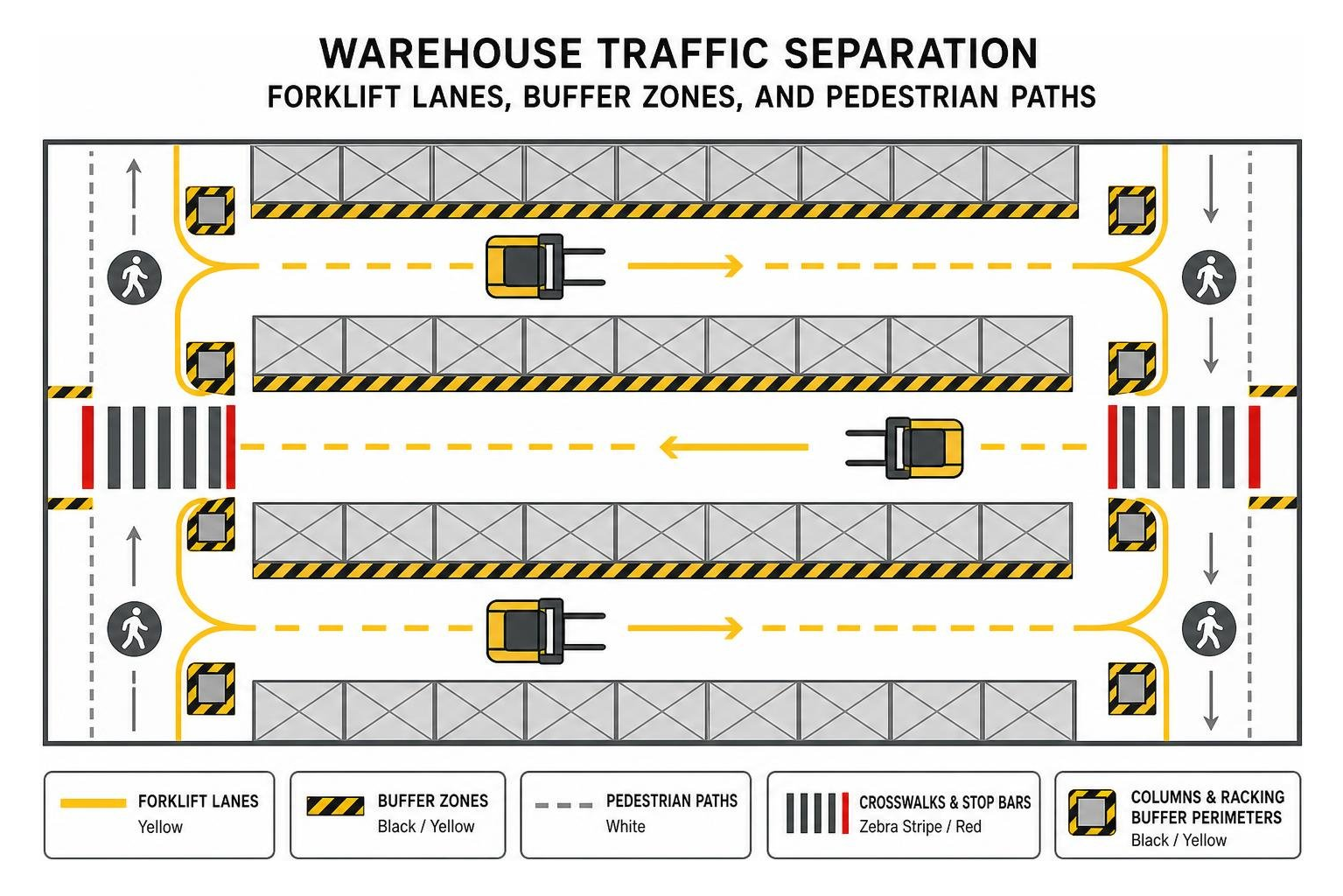
When integrating foot traffic, pedestrian walkways must be physically or visually isolated from motorized routes. For crosswalks intersecting forklift lanes, incorporate zebra-striped pedestrian patterns accompanied by high-visibility stop bars. Establish safety buffer perimeters around racking uprights and building columns to protect infrastructure from recurring vehicle impacts.
Material Comparison: Paint, Epoxy, Tape, and Thermoplastic
Choosing the right material requires balancing upfront installation costs against lifecycle durability, mechanical wear resistance, and operational downtime.
Selecting High-Performance Coatings for Warehouse Aisle Stripping
For long-term commercial installations, resinous floor coatings and hot thermoplastics offer superior resistance against heavy rolling loads:
- Two-Part Epoxy Resins: The industry standard for heavy industrial traffic. Applied as a high-build coating over profiled concrete, epoxy chemically bonds to the slab, yielding an expected service life of 5 to 10 years. Epoxy material costs generally run $50 to $100+ per gallon for professional systems.
- Polyurethane Topcoats: Frequently applied over epoxy bases to add UV stability, scuff resistance, and high chemical tolerance, lasting 3 to 7 years.
- Waterborne Traffic Paint: An economical solution costing $30 to $60 per gallon. While rapid-drying (often curing in 30 to 60 minutes), thin-film paints offer limited abrasion resistance, lasting 12 to 18 months under active forklift traffic.
- Hot-Applied Thermoplastic: Features heat-fused polymers embedded with reflective elements. Thermoplastics provide exceptional bond strength and high retroreflectivity, lasting 10+ years in heavy-duty distribution centers.
| Material Type | Typical Lifespan | Material Cost Benchmark | Cure / Dry Time | Forklift Wear Resistance |
|---|---|---|---|---|
| Waterborne Paint | 12 – 18 Months | $30 – $60 / gal | 30 – 60 Minutes | Low to Moderate |
| Two-Part Epoxy | 5 – 10 Years | $50 – $100+ / gal | 12 – 24 Hours | High |
| Polyurethane | 3 – 7 Years | $70 – $120 / gal | 8 – 16 Hours | High (Scuff Resistant) |
| Thermoplastic | 10+ Years | $3.00 – $8.00 / linear ft | 15 – 30 Minutes | Extreme |
| Industrial Tape | 1 – 3 Years | $1.00 – $2.50 / linear ft | Immediate (Zero) | Moderate to High |
For facilities seeking pre-formed mechanical tape solutions, specialized products like Permastripe Indoor Aisle Marking Tape 75mm provide heavy-duty PVC profiles that install without liquid curing delays.
Temporary Marking Tapes vs Permanent Floor Coatings
While resinous coatings dominate permanent infrastructure layouts, temporary industrial tapes provide vital agility for lean manufacturing, seasonal inventory surges, and reconfigurable 5S staging grids.
Heavy-duty vinyl and composite tapes feature beveled edge profiles that minimize edge fraying from rolling pallet jacks and forklift tires. Products such as Fluorescent Yellow Aisle Marking Tape deliver immediate high-visibility demarcation without toxic fumes or solvent off-gassing, making them ideal for temperature-controlled cold storage and food-grade facilities. When processes evolve, tapes can be lifted cleanly without substrate grinding.
Surface Preparation and Phased Installation Strategies

A floor coating is only as durable as the surface beneath it. Applying premium epoxy over an unprofiled or contaminated concrete floor leads to premature delamination, flaking, and wasted capital.
Concrete Surface Profiling and Mechanical Line Removal
To achieve an enduring mechanical bond, bare concrete must be profiled to International Concrete Repair Institute (ICRI) Concrete Surface Profile (CSP) standards:
- Shot Blasting: Uses high-velocity metallic media to abrade the concrete matrix, opening concrete pores to achieve a CSP 3 to 5. This texture is optimal for high-build industrial epoxies and embedded resin channels.
- Diamond Grinding: Employs rotary diamond tooling to remove old traffic paints and leave a smoother CSP 1 to 2, ideal for thin-film paints and tape applications.
Mechanical preparation completely removes outdated markings and eliminates "ghost lines"—shadowed remnants of old stripes that confuse equipment drivers and OSHA inspectors. Contractors use sealed, HEPA-filtered vacuum systems capturing 99.9% of airborne particulates at the cutting head, preserving inventory cleanliness and indoor air quality. Following profiling, execute thorough substrate degreasing using techniques detailed in the ultimate industrial cleaning guide.
Layout Blueprinting, Laser Guidance, and Application Methods
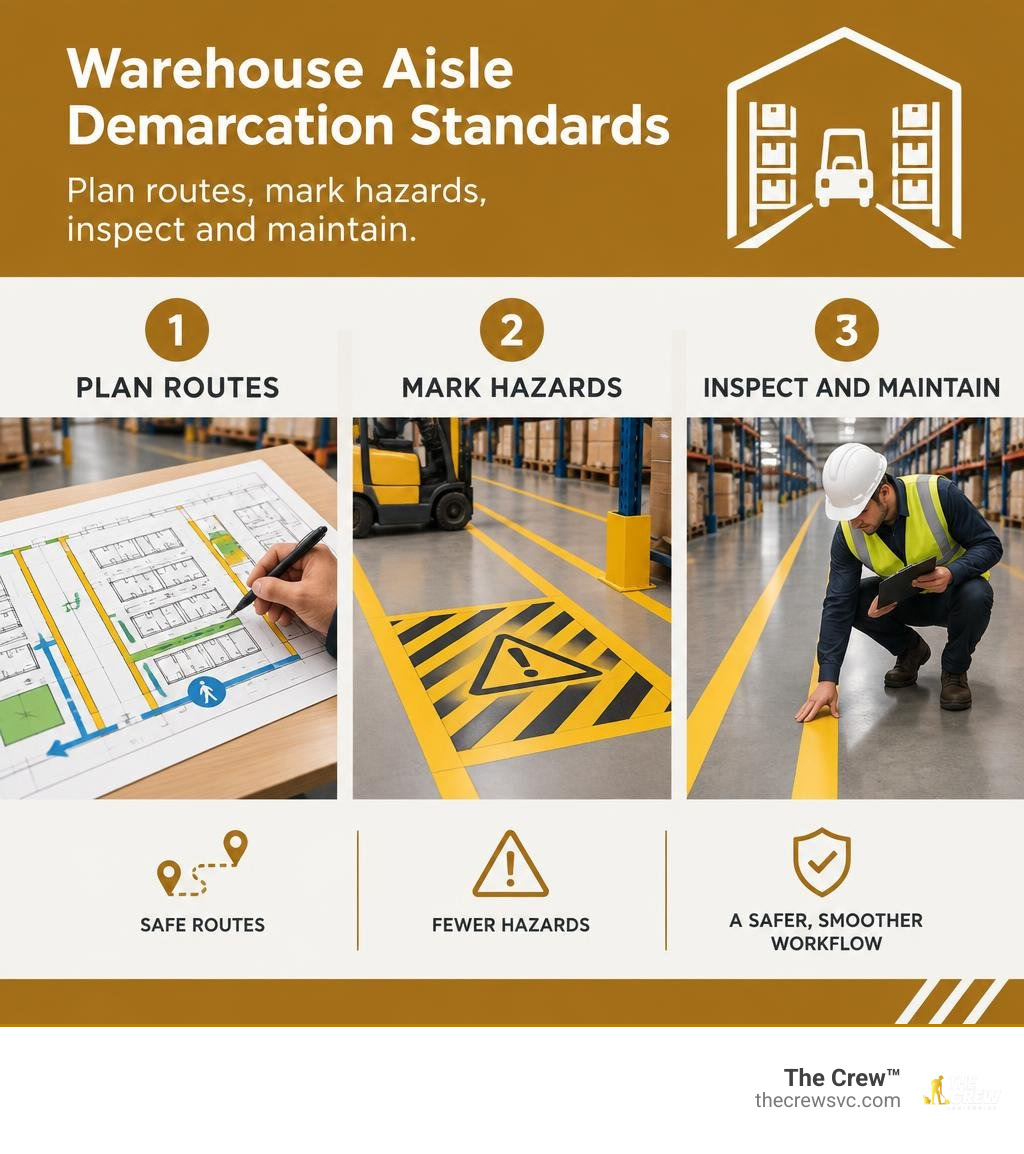
Accurate installation requires translating facility CAD drawings onto the slab using laser-guided layout tools:
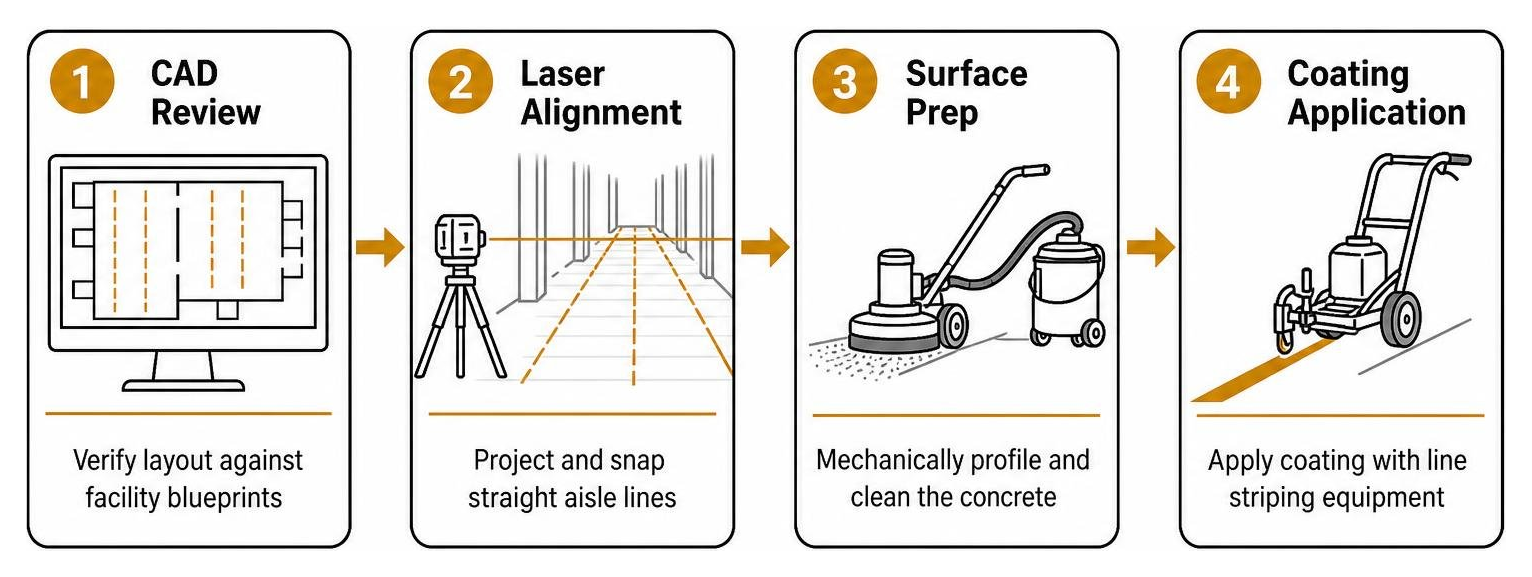
- Blueprint Verification: Cross-reference digital blueprints against physical building columns, dock levelers, and structural obstacles.
- Laser Line Projection: Use self-leveling laser levels and snapped chalk lines to establish straight aisles over hundreds of linear feet.
- Phased Zone Partitioning: Segment the warehouse into operational quadrants. Striping teams apply fast-curing coatings during off-peak weekend or overnight shifts, allowing facilities to maintain shipping commitments.
- Controlled Application: Liquid resins are applied using mechanical line stripers, ensuring uniform film thickness across every linear foot.
For facilities managing complete site revamps, partnering with seasoned providers for industrial cleaning services that wont leave you in the dust guarantees clean concrete conditions before coating application begins.
Maintenance Protocols to Preserve Floor Demarcation
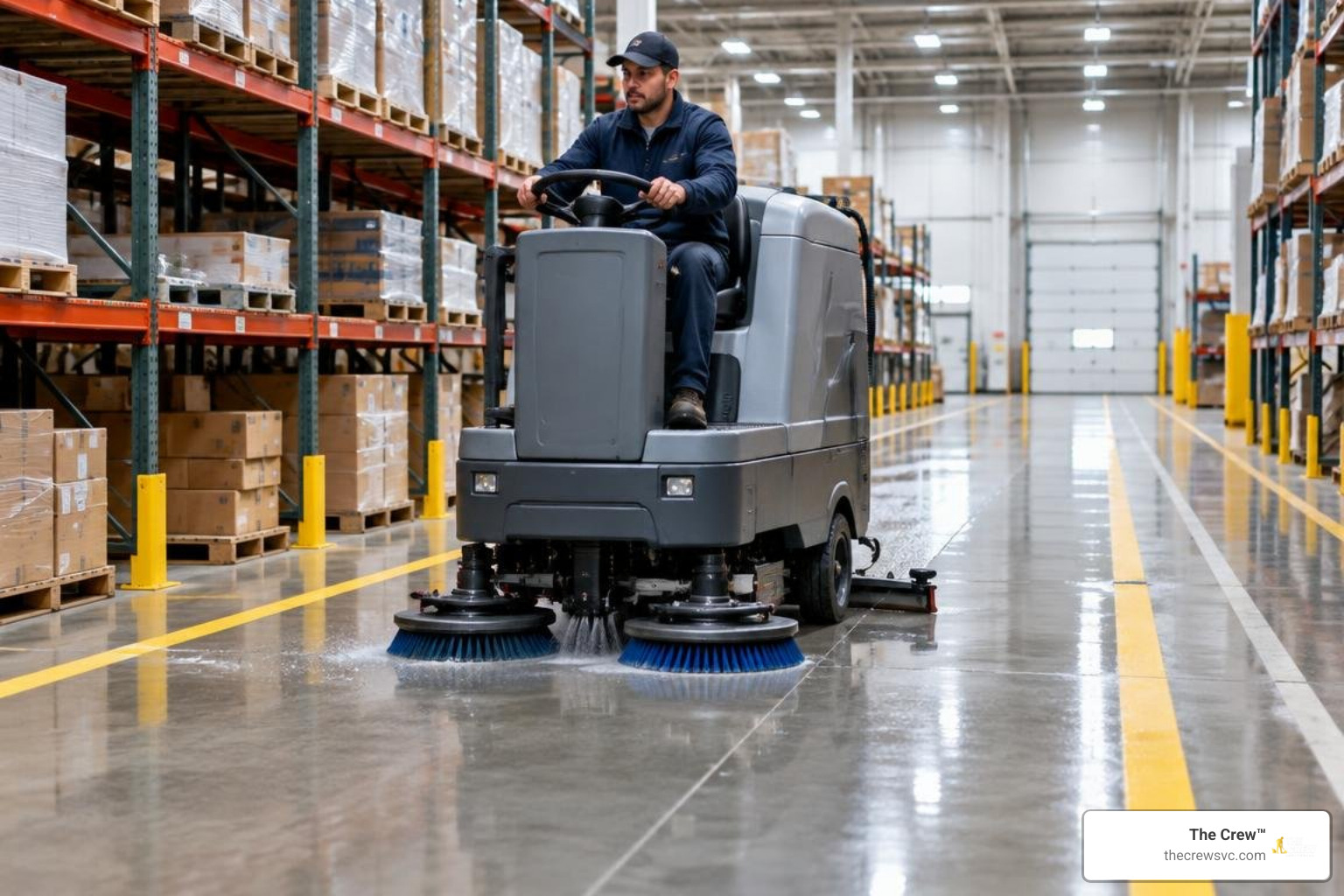
Even industrial-grade epoxy degrades when exposed to embedded abrasive dust, aggressive scrubbing pads, and improper material handling habits.
Best Practices for Maintaining Warehouse Aisle Stripping Visibility
Preserving clear line demarcation requires daily housekeeping and operational discipline:
- Optimize Auto-Scrubber Settings: Adjust commercial floor scrubbers to use soft-to-medium nylon brushes and neutral-pH detergents. Avoid aggressive black stripping pads over painted lines, which rapidly abrade protective topcoats.
- Implement "Lift Clear" and "Turn Clear" Rules: Train forklift operators never to turn steering wheels while parked stationary on striped lines, and strictly prohibit dragging wooden pallet runners across painted walkways.
- Routine Tire Mark Removal: Lift rubber residue promptly using specialized industrial citrus degreasers before vulcanized rubber bonds to the resin.
- Surface Care Integration: Incorporate ongoing floor maintenance through certified Denver floor maintenance services to protect both concrete densifiers and demarcation topcoats across your facility.
Recoating Schedules and Touch-Up Protocols
Establish a proactive audit schedule to preserve visibility:
- Monthly Audits: Conduct visual safety walks to identify localized chipping, fading, or edge peel at high-traffic intersections.
- Targeted Touch-Ups: Repair localized damage immediately using rapid-cure polyaspartic coatings to prevent wear from migrating along the line.
- Lifecycle Overhauls: Plan for full recoating cycles every 3 to 5 years for high-wear turning intersections and every 5 to 10 years for straight primary runs.
Frequently Asked Questions About Warehouse Floor Markings
How wide should warehouse floor striping lines be?
OSHA standard 1910.22 establishes a minimum acceptable line width of 2 inches. However, the logistics industry standard for clear visibility across wide facilities is 4 inches. Perimeter boundaries, danger zones, and high-traffic forklift thoroughfares frequently employ 6-inch lines to ensure optimal distance visibility.
How long do epoxy floor stripes last compared to industrial tape?
Two-part epoxy markings installed over mechanically shot-blasted concrete typically last 5 to 10 years under active industrial traffic. Heavy-duty industrial floor tapes generally deliver a lifespan of 1 to 3 years, though tapes provide the advantage of instant installation without curing downtime.
Can aisle striping be installed without halting warehouse operations?
Yes. Professional line striping projects can be phased by zone, aisle, or shift. By utilizing rapid-curing polyaspartic resins (curing in 2 to 4 hours) or heavy-duty peel-and-stick tapes during off-peak night shifts, warehouses can remain fully operational without closing fulfillment lines.
Maximize Facility Safety and Compliance with The Crew™
Clear, code-compliant aisle striping is essential for workplace safety, regulatory compliance, and warehouse workflow efficiency. Implementing proper layout geometries, selecting high-performance materials, and maintaining clean floors helps logistics facilities avoid costly collisions and maintain steady throughput.
At The Crew™, we help commercial and industrial facilities across Denver, Aurora, Lakewood, Centennial, and the surrounding metro communities protect their infrastructure. Our fully background-checked cleaning professionals deliver reliable care designed to keep your floors clean, compliant, and visible.
Explore our complete commercial floor service options today to keep your operational pathways clean, safe, and ready for work.