Why Understanding Sanitize vs Disinfect vs Sterilize Matters for Your Business
When it comes to sanitize vs disinfect vs sterilize, these three terms are not interchangeable — and using the wrong method on the wrong surface can leave your employees and customers exposed to harmful pathogens.
Here's a quick breakdown:
| Process | What It Does | Germ Reduction | Typical Use |
|---|---|---|---|
| Cleaning | Physically removes dirt and some germs | Varies | Always the first step |
| Sanitizing | Reduces bacteria to safe levels | 99.9% of bacteria | Food-contact surfaces, toys |
| Disinfecting | Kills bacteria and viruses | 99.999% of germs (EPA standard) | High-touch surfaces, illness situations |
| Sterilizing | Eliminates all microbial life | 100% | Medical and dental instruments |
The key differences in plain terms:
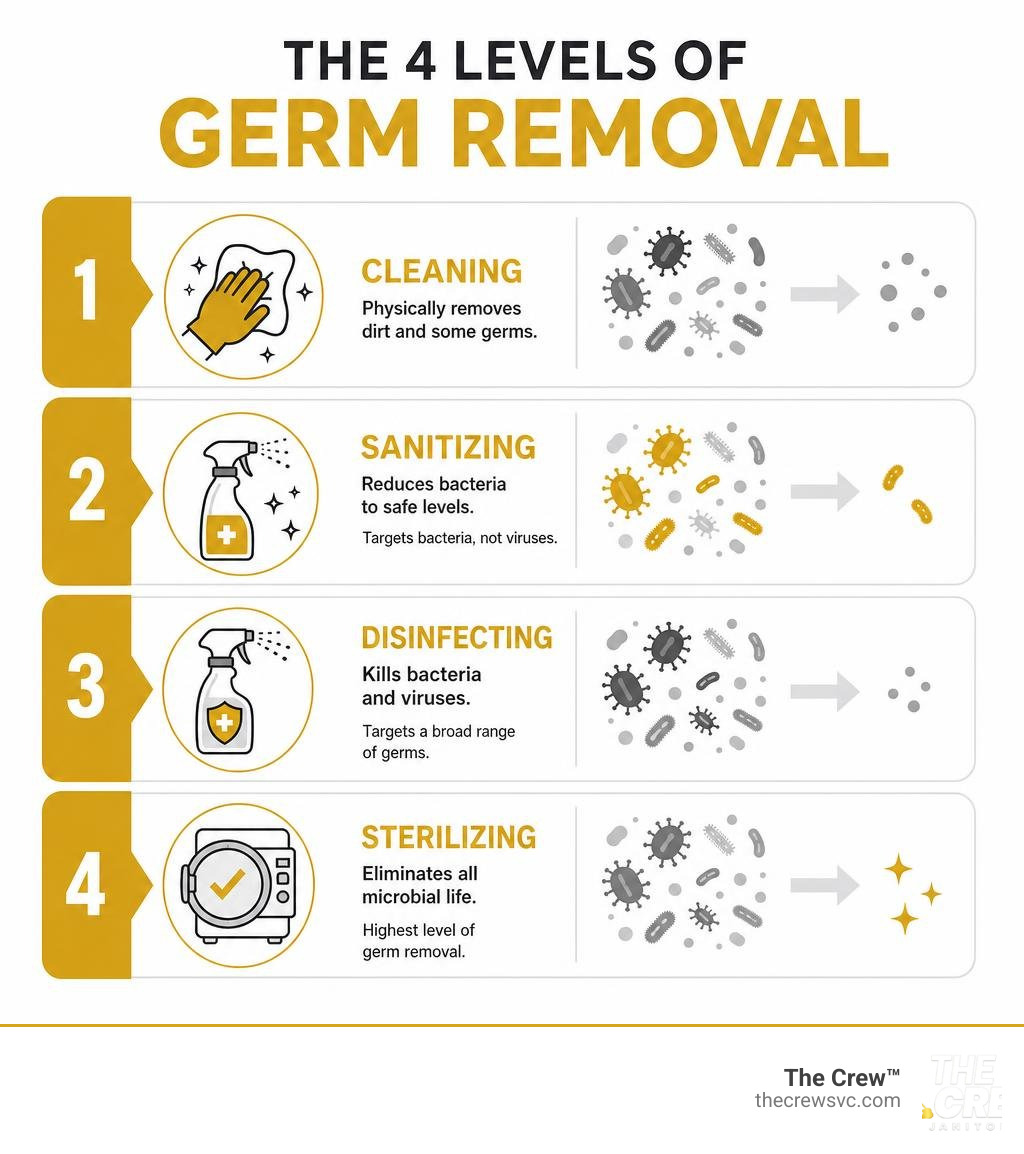
- Cleaning removes dirt but doesn't kill germs
- Sanitizing targets bacteria but not viruses
- Disinfecting kills both bacteria and viruses
- Sterilizing is the highest level — used in medical settings, not typical offices or kitchens
Most people assume a surface that looks clean is safe. It isn't. And in a busy Denver office, lobby, or commercial facility, that misconception can spread illness fast.
I'm Carlos Castillo II, owner of The Crew™ Janitorial — a commercial cleaning company serving the Denver Metro Area since 1982 — and applying the right level of germ control to the right surface is something I deal with every day. In this guide, I'll walk you through exactly how to navigate sanitize vs disinfect vs sterilize so your facility stays genuinely clean, not just visibly tidy.
The Crucial First Step: Why Cleaning Must Always Precede Decontamination
If you walk away with only one piece of advice from this guide, let it be this: you cannot sanitize, disinfect, or sterilize a dirty surface.

Cleaning is the indispensable physical foundation of any decontamination process. It involves using soap or detergents and water alongside mechanical action—scrubbing, wiping, washing, and rinsing—to physically remove visible dirt, dust, organic matter, and a significant portion of surface germs.
While cleaning does not necessarily kill bacteria, viruses, or fungi, it physically displaces them. More importantly, it removes the "soil barrier."
Organic matter like grease, spilled food, dust, and bodily fluids acts as a protective shield for microorganisms. If you spray a disinfectant directly onto a dusty desk or a grease-splattered countertop, the chemical solution is absorbed or neutralized by the soil before it can ever reach the pathogens underneath. This biological shielding renders even the strongest disinfectants completely useless.
To maintain a healthy workspace, property managers and business owners must establish strict multi-step protocols. To see how this fits into a broader facility maintenance plan, check out The Complete Checklist of Commercial Cleaning Services or read through our comprehensive Commercial Cleaning 101 for Property Managers to keep your properties in pristine, hygienic condition.
Sanitize vs Disinfect vs Sterilize: The Hierarchy of Germ Control
To protect your facility from pathogens, it is helpful to view decontamination as a strict hierarchy of microbial control. Each level has distinct goals, chemical concentrations, and regulatory standards.
1. Cleaning
- Goal: Physical removal of soil and reduction of surface pathogens.
- Method: Soap, water, and mechanical friction.
- EPA Regulation: The EPA does not regulate pure cleaning products unless they make specific antimicrobial claims.
2. Sanitizing
- Goal: Reduce bacterial populations to levels deemed safe by public health standards.
- Efficacy: Must kill at least 99.9% of target bacteria on a surface within a specified time.
- Limitation: Sanitizing is designed primarily for bacteria and is generally not formulated to eliminate viruses or fungi.
- Regulatory Standard: Regulated by the EPA as an antimicrobial pesticide. To explore how these products are categorized, see the EPA guidelines on surface products.
3. Disinfecting
- Goal: Destroy or irreversibly inactivate both bacteria and viruses on hard, non-porous surfaces.
- Efficacy: Must meet rigorous EPA testing standards, proving a 99.999% reduction of specified pathogens.
- Limitation: While highly effective against active vegetative bacteria, viruses, and fungi, standard disinfectants do not reliably destroy highly resistant bacterial spores.
- Regulatory Standard: Undergoes significantly more rigorous testing than sanitizers before receiving EPA registration.
4. Sterilizing
- Goal: Complete destruction of all forms of microbial life, including vegetative bacteria, viruses, fungi, parasites, and highly resilient bacterial spores.
- Efficacy: 100% elimination.
- Methods: High-pressure steam (autoclaving), dry heat, ethylene oxide gas, hydrogen peroxide gas, or ionizing radiation.
- Typical Setting: Exclusively used in medical, dental, and laboratory environments. It is neither practical nor necessary for standard commercial offices, schools, or retail spaces.
To better understand how these terms compare in commercial environments, you can read the industry breakdown on Cleaning vs. Sanitizing vs. Disinfecting | Kimberly-Clark Professional.
Practical Applications and Safety Protocols: When and How to Decontaminate
Selecting the appropriate method in the sanitize vs disinfect vs sterilize spectrum depends on three key factors: the surface material, the level of exposure risk, and the presence of active illness.
Understanding Sanitize vs Disinfect vs Sterilize in Food Service
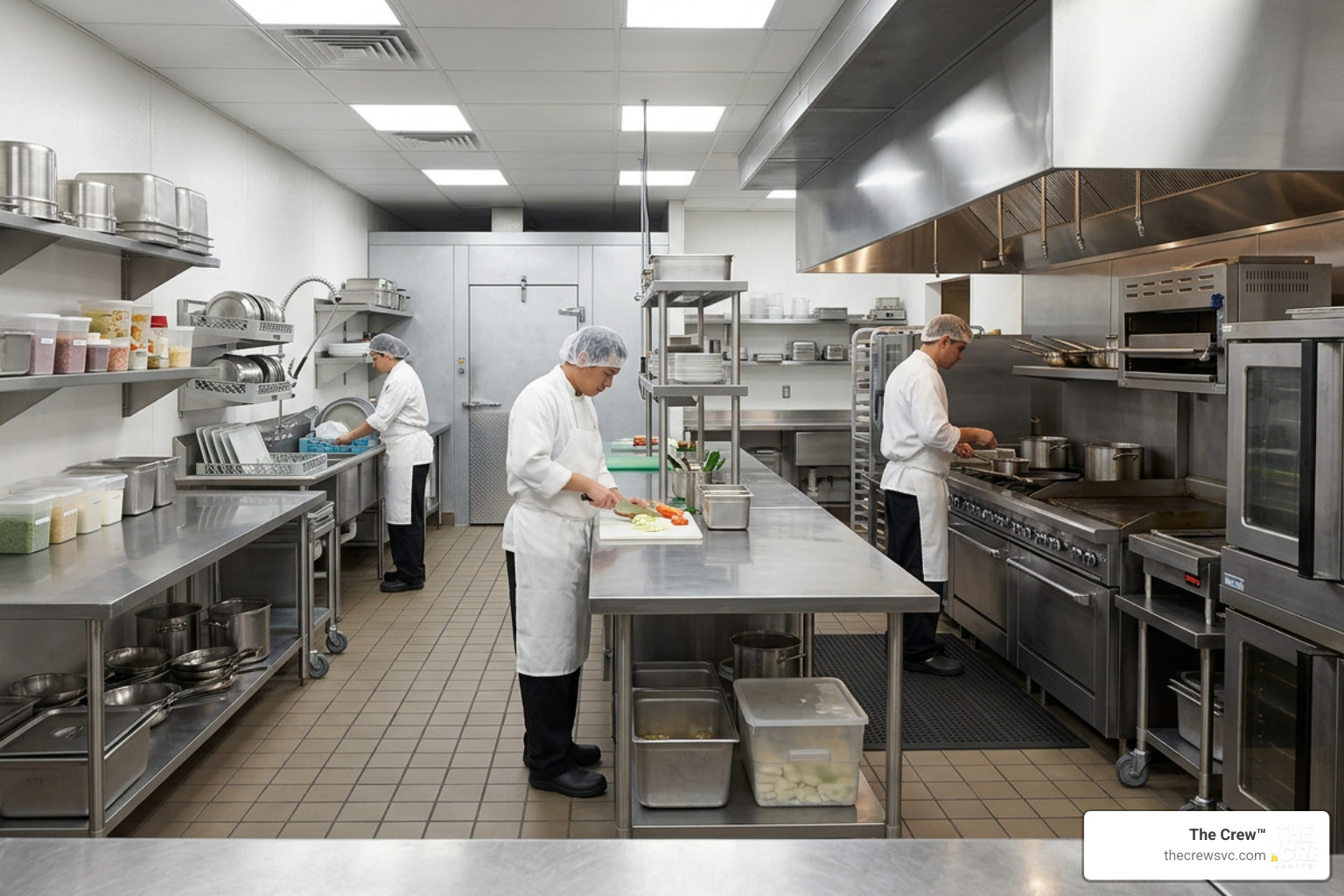
In commercial kitchens and breakrooms across Lakewood, Broomfield, and Westminster, food safety is paramount.
For surfaces that directly touch food—such as cutting boards, prep counters, utensils, and dishes— sanitizing is the standard. You want to reduce bacteria like E. coli and Salmonella to safe levels without leaving behind toxic chemical residues that could contaminate food.
Using a heavy-duty disinfectant on a food-prep surface can be dangerous unless the surface is thoroughly rinsed with potable water afterward. Sanitizers, often formulated with lower chemical concentrations, are designed to dry safely on these surfaces.
Conversely, non-food-contact surfaces in a kitchen, such as trash cans, refrigerator door handles, and floors, should be regularly disinfected to prevent cross-contamination.
To ensure your food service establishment meets local health codes, read our How to Keep Your Denver Restaurant Inspection-Ready guide, and consult the Sanitizing vs. Disinfecting - Douglas County resources for local public health standards.
Choosing Sanitize vs Disinfect vs Sterilize for Commercial Facilities
For standard commercial buildings in cities like Aurora, Centennial, and Longmont, your primary focus will be choosing between sanitizing and disinfecting for high-touch surfaces.
- High-Touch Surfaces: Doorknobs, light switches, elevator buttons, shared keyboards, and conference room tables should be regularly disinfected, especially during cold and flu season or if a viral outbreak (such as SARS-CoV-2 or Norovirus) is suspected. Because viruses spread rapidly on these surfaces, a sanitizer is insufficient; you need an EPA-registered disinfectant to completely kill viral pathogens.
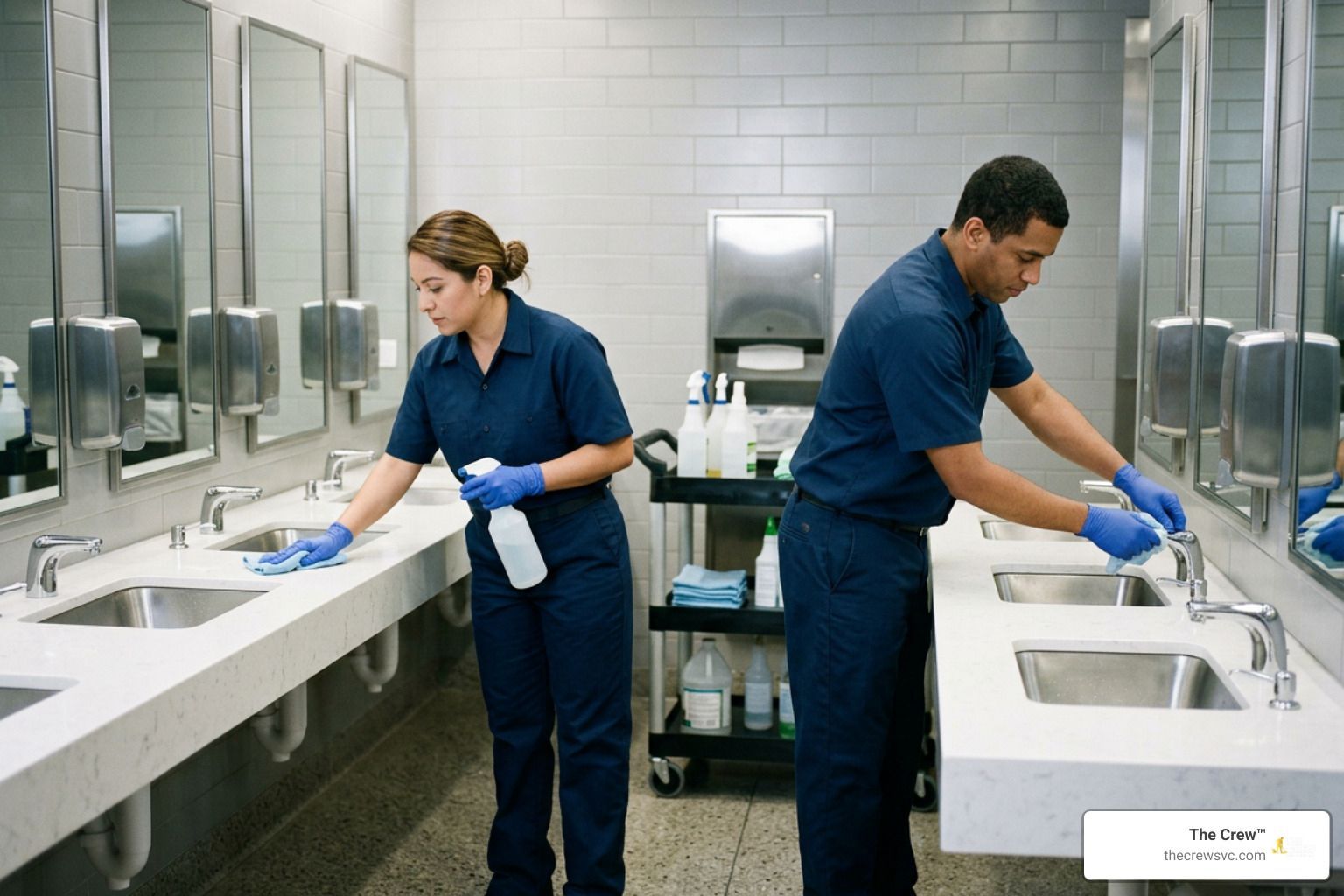
- Restrooms: Toilets, sinks, faucets, and diaper-changing stations require routine disinfection. These areas are prone to bodily fluids and hazardous bacteria, making deep disinfection necessary to protect public health. To optimize your restroom cleaning routines, read our guide on How to Master Commercial Restroom Sanitation.
- Medical and Dental Instruments: If your facility operates in the healthcare sector, any instrument that penetrates skin or enters sterile areas of the body must undergo professional sterilization. For an in-depth look at medical-grade decontamination, review Healthline's analysis of disinfection and sterilization.
Safety Protocols and Chemical Handling Best Practices
Using powerful sanitizers and disinfectants requires strict adherence to safety protocols to protect janitorial staff and building occupants.
- Dwell Time (Contact Time): This is the amount of time a surface must remain visibly wet with the chemical to kill the targeted pathogens. Many commercial disinfectants require a dwell time of anywhere from 4 to 10 minutes. Wiping the product off immediately after spraying is a common mistake that results in incomplete germ elimination.
- Ventilation: Always apply chemical disinfectants in well-ventilated spaces. Poor airflow can lead to the buildup of volatile organic compounds (VOCs), causing respiratory irritation or triggering asthma attacks in sensitive individuals.
- Chemical Mixing Hazards: Never mix cleaning chemicals. Combining bleach-based products with ammonia- or acid-based cleaners creates highly toxic chloramine or chlorine gases, which can be fatal if inhaled.
- Personal Protective Equipment (PPE): Staff should always wear appropriate PPE, including chemical-resistant gloves and safety goggles, when handling concentrated sanitizers or disinfectants.
- Storage: Store all chemicals in their original, labeled containers in a cool, dry, and secure location out of reach of children or unauthorized personnel.
Emergency Safety Note : If an employee or occupant experiences accidental chemical exposure to the skin, eyes, or via inhalation, immediately Call Poison Control at 1-800-222-1222 for expert medical guidance.
For a deeper dive into safe mixing ratios, chemical safety, and the science of sanitizing agents, refer to the Virginia Tech research on cleaning and sanitizing.
Frequently Asked Questions About Surface Decontamination
Can you combine cleaning and disinfecting into a single step?
Yes, but only under specific conditions. There are many "two-in-one" cleaner-disinfectant products (such as pre-saturated disinfecting wipes) available on the market. However, their efficacy depends entirely on the level of soil present.
If a surface has visible dirt, dust, grease, or spills, you must perform a pre-cleaning step first. If the surface is already visually clean, a combined product can clean and disinfect simultaneously, provided you apply enough liquid to keep the surface wet for the full contact time specified on the product label.
What is the difference between EPA-registered disinfectants and sanitizers?
The primary difference lies in the types of pathogens they are proven to kill and the rigorousness of their regulatory testing:
- Sanitizers are formulated to reduce bacterial populations on surfaces by 99.9%. They are generally not tested or registered to kill viruses or fungi.
- EPA-Registered Disinfectants must pass stringent testing to prove they kill 99.999% of specified bacteria, viruses, and fungi.
To learn more about how these labels impact your product selection, you can read The Big Difference Between Sanitizing and Disinfecting or check out Disinfecting vs. Sanitizing Explained—and When to Use Each.
Why does contact time matter so much for germ elimination?
Contact time, or "dwell time," is the exact duration a chemical must remain wet on a surface to successfully destroy targeted pathogens. Germs are resilient; they do not die instantly upon contact with a spray. If a disinfectant label specifies a 10-minute contact time, and the product evaporates or is wiped away after 30 seconds, you have not disinfected the surface—you have simply created a false sense of security while leaving active pathogens behind.
Conclusion
Understanding the distinct roles of sanitize vs disinfect vs sterilize is essential for maintaining a safe, healthy, and compliant commercial space. Whether you manage a corporate office in Denver, a medical clinic in Englewood, or a school in Arvada, matching the correct level of decontamination to your specific surfaces protects your staff, clients, and bottom line.
Executing these multi-step cleaning and disinfection protocols consistently requires expertise, precision, and reliable staff. At The Crew™, we provide premier commercial cleaning and janitorial services throughout the Denver Metro Area—including Aurora, Lakewood, Westminster, Broomfield, Centennial, Parker, Golden, Wheat Ridge, Littleton, and beyond.
Our unique advantage? We hire and retain top-tier, background-checked cleaners and maintain a 0% turnover rate, ensuring your facility receives consistent, reliable, and scientifically sound cleaning service every single visit.
Ready to elevate the health and safety of your facility? Partner with professional commercial cleaning services at The Crew™ today, and let our expert team handle the details of keeping your space truly clean.