Why Professional Cleaners Zero Turnover Matters More Than Any Deep Clean
If you manage a Denver-area office or commercial facility, professional cleaners zero turnover is the single biggest factor separating reliable service from a revolving door of strangers in your building.
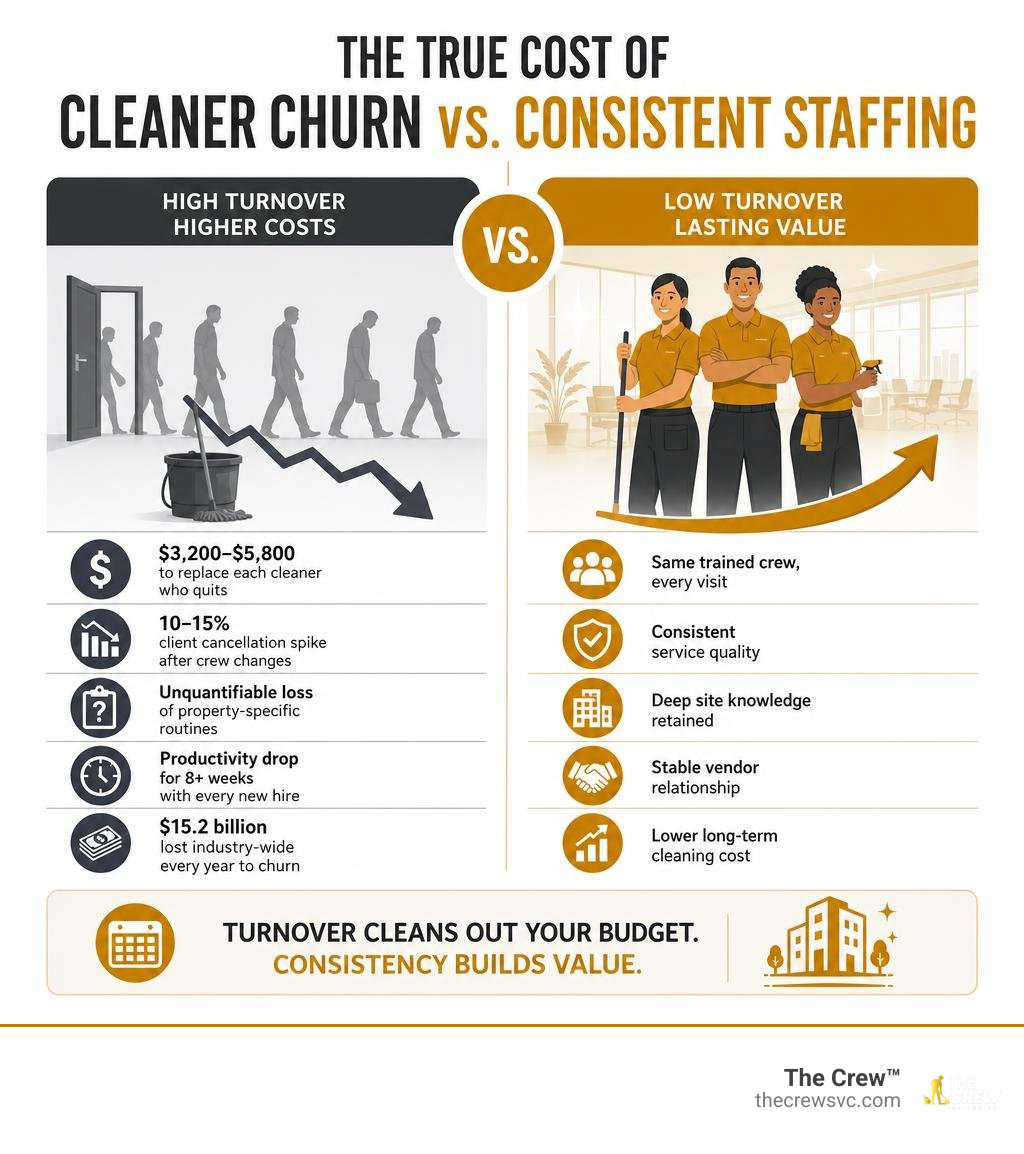
Here is what low-turnover cleaning means for your property:
| What You Get | What High Turnover Costs You |
|---|---|
| Same trained crew, every visit | $3,200–$5,800 to replace each cleaner who quits |
| Consistent service quality | 10–15% client cancellation spike after crew changes |
| Deep site knowledge retained | Unquantifiable loss of property-specific routines |
| Stable vendor relationship | Productivity drop for 8+ weeks with every new hire |
| Lower long-term cleaning cost | $15.2 billion lost industry-wide every year to churn |
The U.S. cleaning industry averages roughly 200% annual turnover — meaning a 50-person company replaces its entire workforce twice every year. For business owners, that is not an HR statistic. It is a direct threat to service quality, staff trust, and your facility's long-term cleanliness.
A single deep clean will not fix that. Consistency will.
I'm Carlos Castillo II, owner of The Crew Janitorial, a family-run commercial cleaning company serving the Denver Metro Area since 1982 — and keeping professional cleaners at zero turnover levels is one of the core operational disciplines that defines how we operate. In this guide, I'll walk you through exactly how stable, low-turnover cleaning crews protect your property, your budget, and your peace of mind.
The Financial Reality: Periodic Deep Cleans vs. Consistent Staffing
Many property managers across Denver, Lakewood, and Broomfield attempt to resolve declining facility standards by ordering periodic, heavy-duty deep cleans. While a deep clean removes accumulated grime, it acts as a short-term band-aid on a chronic operational problem. When a cleaning company suffers from revolving-door staffing, daily sanitation standards inevitably slip, creating an expensive cycle of neglect followed by emergency remediation.
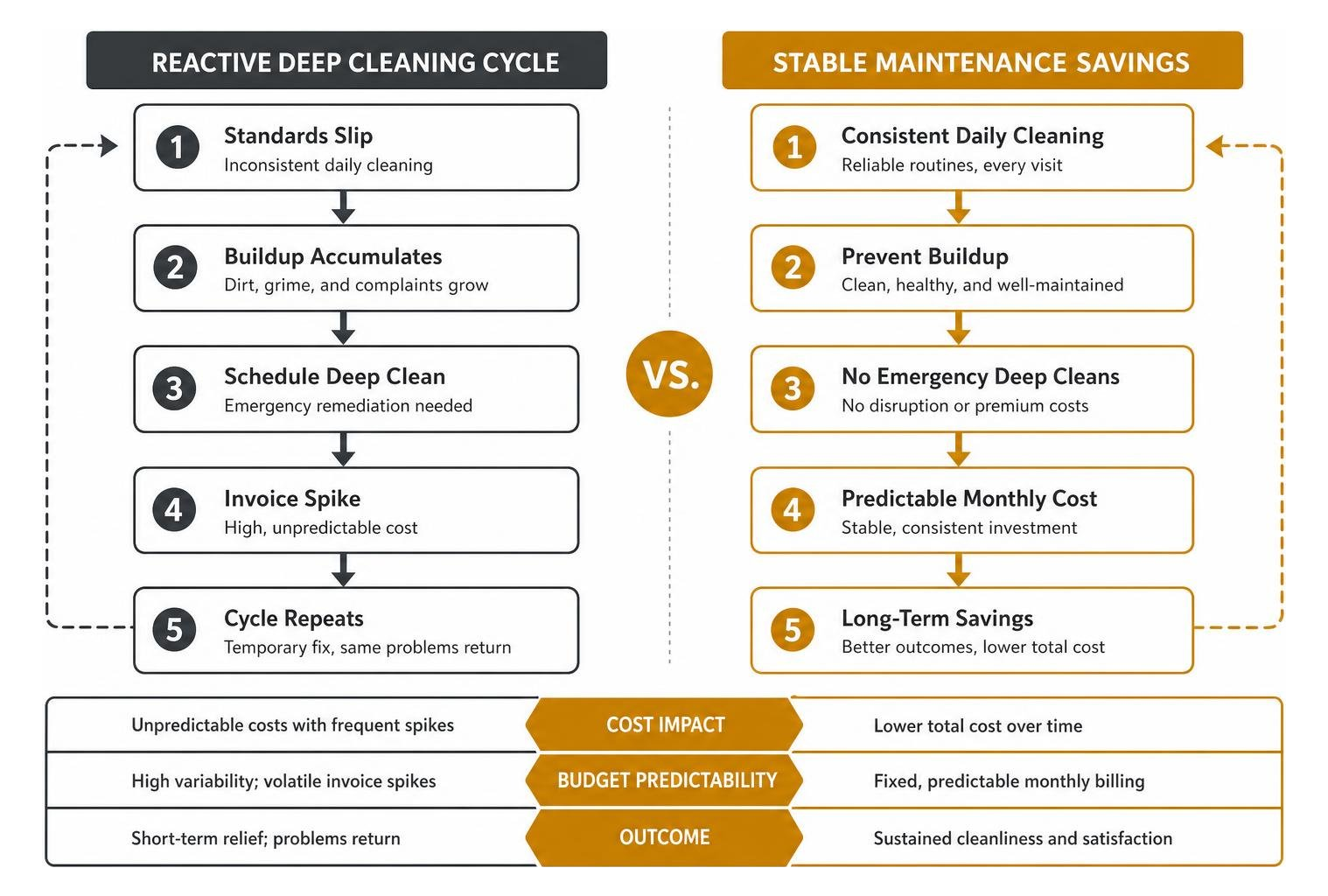
When you contrast the financial dynamics of reactive deep cleaning with zero staff turnover cleaning, the structural savings of team stability become obvious:
| Metric | Reactive Deep Cleaning Cycle | Dedicated, Stable Cleaning Crew |
|---|---|---|
| Budget Predictability | High variability; volatile invoice spikes | Fixed, predictable monthly billing |
| Direct Replacement Cost Burden | High indirect costs passed through service fees | Minimal overhead drag; sustained workforce |
| Productivity Efficiency | Cleaners learn site layout from scratch every time | 100% operational velocity from Day 1 |
| Facility Wear and Tear | High asset degradation between deep cleans | Daily preventive surface and floor care |
| Facility Management Stress | High supervisor drag and constant oversight | Autonomous, trusted execution |
Replacing a single frontline cleaner costs a facility service provider between $3,200 and $5,800 when factoring in direct hiring expenses, administrative intake, uniform issuing, and supervisory oversight. When a cleaning firm loses staff constantly, these replacement costs silently inflate contract pricing or destroy service quality.
Furthermore, every new hire undergoes a productivity ramp-up curve. During the first week on a job site, a new cleaner operates at roughly 65% efficiency, rising to 85% by week four, and only reaching full operational speed around week eight. That represents 24.5 equivalent lost workdays during the onboarding ramp alone.
The Hidden Drag of Cleaner Churn and Client Risk
Beyond raw recruiting expenses, worker churn introduces serious hidden costs that erode property management outcomes. The most vulnerable period for frontline attrition is the "60-Day Cliff": roughly 30% of new hires depart within their first 90 days, with 20% quitting within the first 45 days.
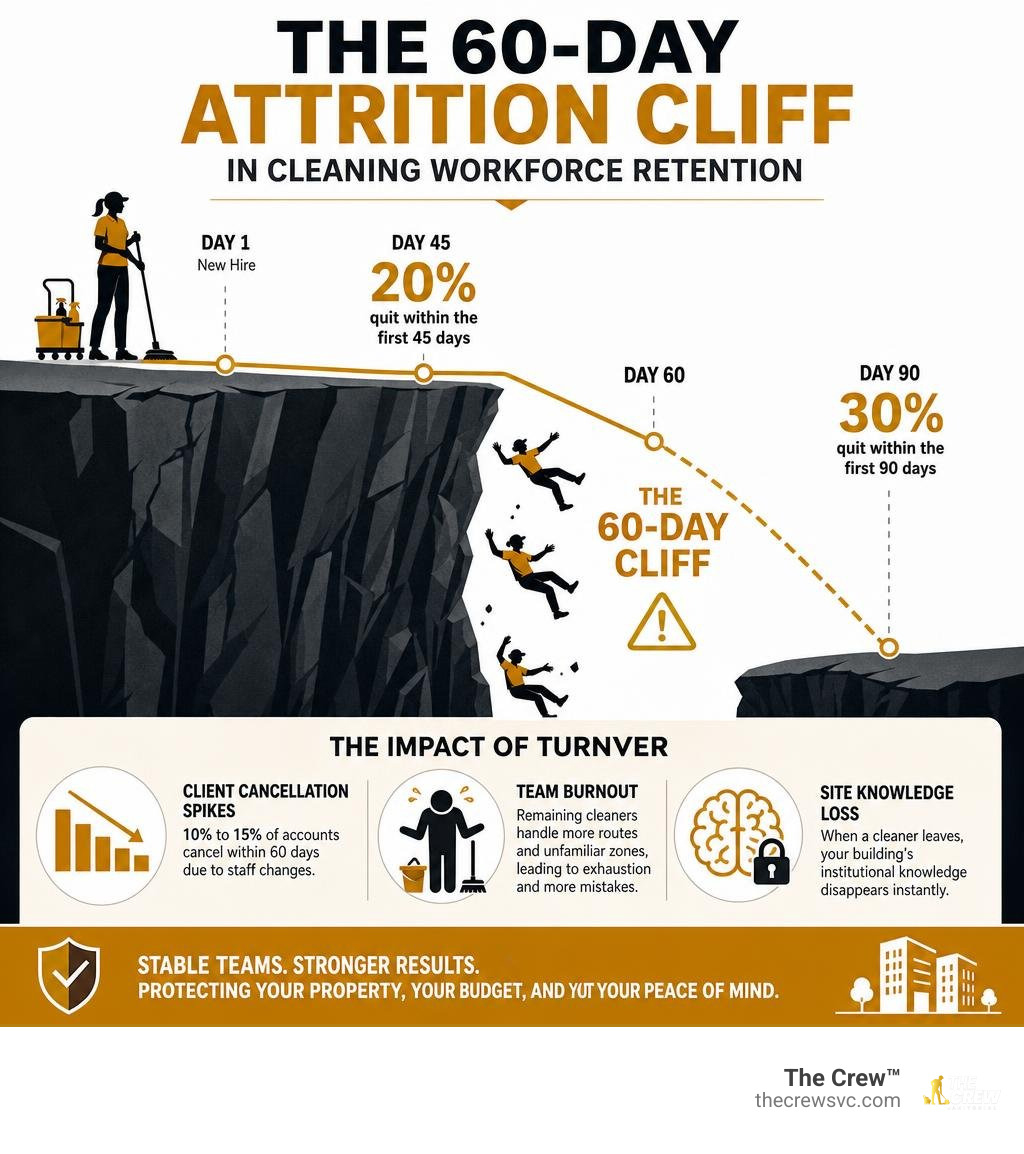
This churn directly harms account stability:
- Client Cancellation Spikes: Data demonstrates that reassigning or rotating cleaning technicians triggers a 10% to 15% account cancellation rate within 60 days due to broken client trust.
- Team Burnout: Remaining cleaners must double up on routes and cover unfamiliar zones, leading to exhaustion and higher error rates.
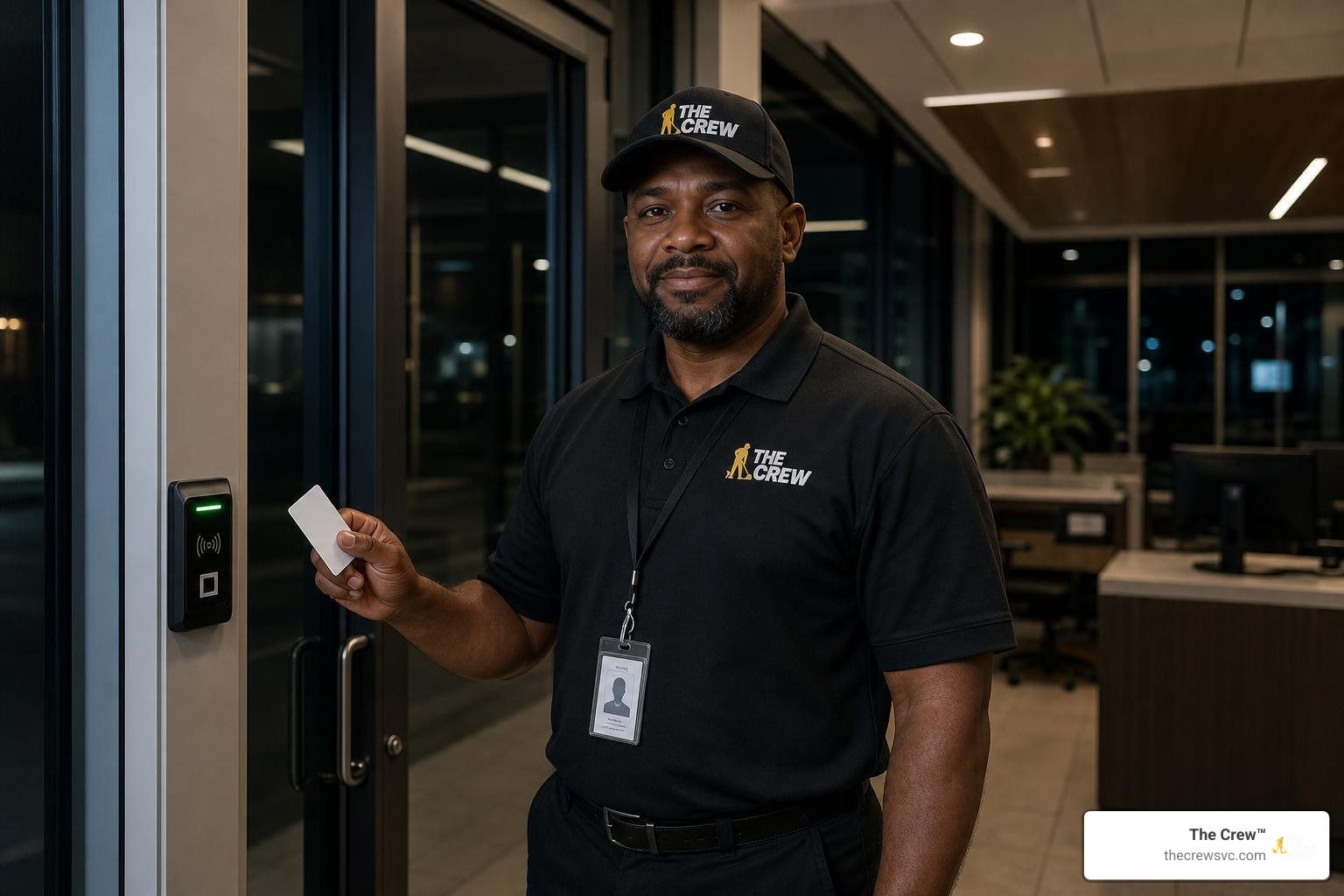
- Unquantifiable Site Knowledge Loss: A stable cleaner learns the nuances of your building - such as which suite doors require special keycard handling, which tenant's office has delicate finishes, or which security alarm keypads trigger easily. When that cleaner leaves, that institutional memory vanishes instantly.
Choosing office cleaning zero turnover partners ensures that tacit building knowledge stays on site week after week, preventing security slip-ups and service failures.
Why Wage Competition from Logistics Demands Better Retention
In competitive employment markets like Commerce City, Aurora, and Centennial, cleaning companies face severe wage pressure from warehouse, fulfillment, and logistics hubs. The national median wage for janitorial workers sits around $17.27 per hour, according to Bureau of Labor Statistics occupational wage data- roughly 27% below the national median hourly wage for general labor. Because lateral mobility is frictionless, a worker can easily step across the street for a minor hourly bump at a distribution center.
To combat this wage gap without forcing massive price hikes on property owners, top-tier cleaning companies leverage powerful retention strategies:
- Strong Employer Branding: Creating a culture where frontline technicians are respected as health professionals reduces cost-per-hire by 50% and slashes attrition by 28%.
- Earned Wage Access (EWA): Providing flexible, same-day access to accrued earnings correlates with a 21% drop in staff churn.
- Non-Monetary Retention Incentives: predictable routes, daylight shift availability, and structured career progression give cleaning staff stability that warehouse environments rarely match.
Why Professional Cleaners Zero Turnover Creates Superior Long-Term Property Value
Consistent maintenance provided by stable crews preserves physical building assets far better than occasional restoration cleans. High-traffic commercial flooring, custom woodwork, and HVAC filtration systems require continuous, precise care. When the same trained technicians care for your building daily, subtle signs of wear or minor moisture issues are spotted and addressed before turning into multi-thousand-dollar repair bills.
Our team focuses heavily on implementing rigorous vetted background cleaners across Littleton, Arvada, Golden, and Englewood, ensuring that property managers enjoy total peace of mind regarding facility safety and long-term asset preservation.
How Professional Cleaners Zero Turnover Extends Client Lifetime Value
For property managers and building owners, vendor stability translates directly into higher tenant satisfaction and longer lease renewals. Reassignment friction occurs every time a new cleaning face enters a commercial office space, creating trust deficits among facility personnel and building tenants.
When staff turnover is virtually eliminated:
- Account Retention Soars: Commercial cleaning contract retention approaches 98% when crew continuity is maintained, compared to the industry average where accounts churn every three to four years.
- Trust Preservation: Building tenants build rapport with regular cleaning technicians, building a secure and comfortable working environment.
- Customer Satisfaction Metrics: Consistent service eliminates recurring ticket complaints, allowing property managers to focus on core operations rather than managing vendor deficiencies.
Safety, Compliance, and Risk Mitigation via W-2 Employment Models
A major risk factor in commercial facility management is the widespread misuse of 1099 independent contractors by low-cost cleaning providers. Independent contractor models lack direct supervisory control, consistent safety oversight, and standardized background checks.
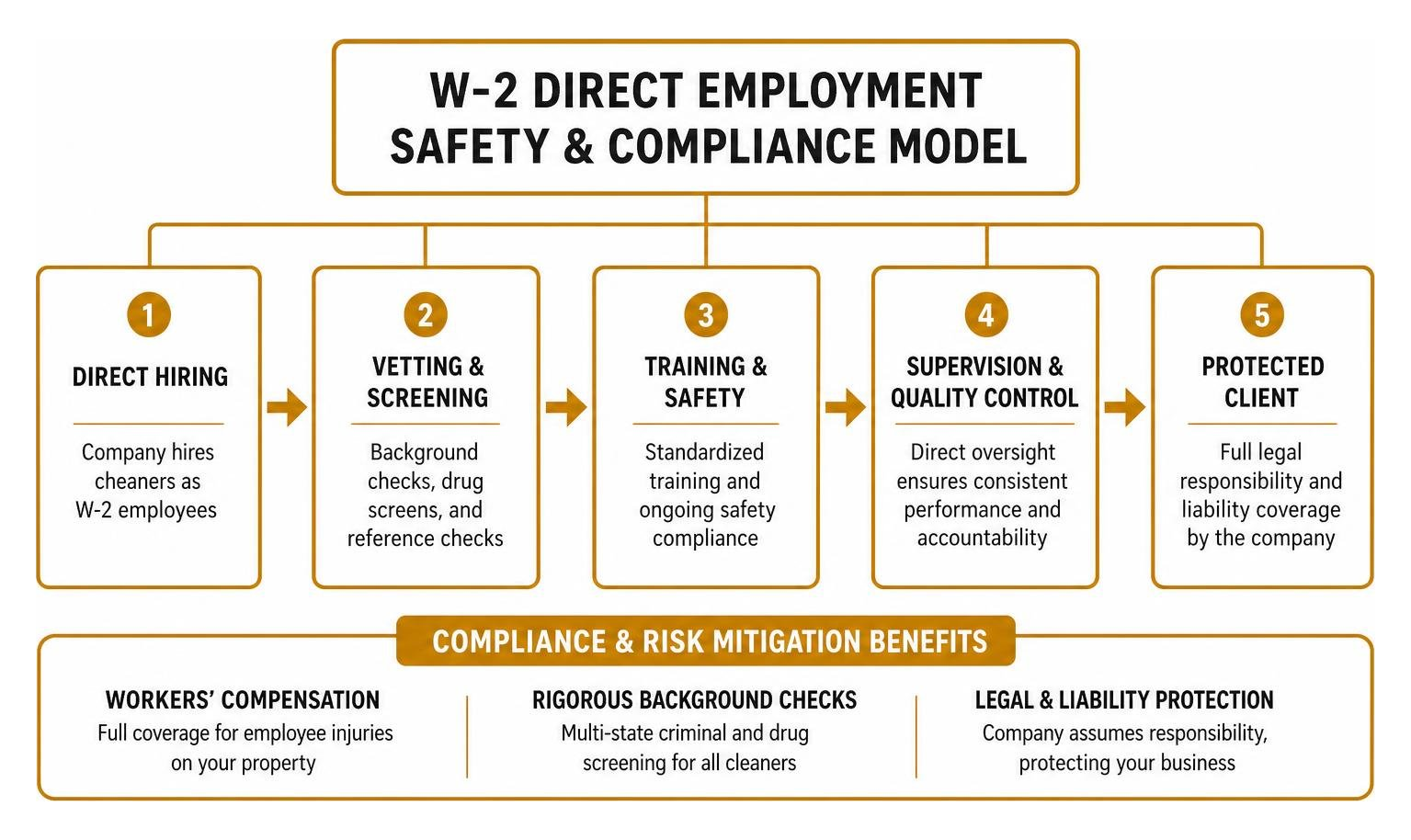
By contrast, operating under direct W-2 employment structures — similar to top standards in W-2 employment models in house cleaning services — guarantees that the cleaning company maintains direct legal accountability for workforce training, safety compliance, and quality control.
Key compliance advantages of W-2 staffing models include:
- Workers' Compensation Coverage: Full protection against worker injury liability on your property, shielding facility owners from costly premises liability lawsuits.
- Rigorous Background Checks: Multi-state criminal background screening and drug panel checks conducted prior to any technician setting foot in your building.
- Mandatory Safety Training: Nationally, only 30% of cleaners receive formal safety training before their first shift. W-2 operations enforce comprehensive OSHA chemical handling, bloodborne pathogen, and slip-and-fall prevention training.
How Commercial Cleaning Operations Achieve Low Turnover: The 5 High-ROI Retention Levers

Achieving low turnover in a labor-heavy industry is not a matter of luck — it is the result of systematic operational choices. Modern commercial cleaning operators use quantitative retention models to drastically lower frontline churn.
Calculated across a 20-cleaner team, a 10% improvement in retention yields a 203% return on retention investments, boosting net profit margins by as much as 30.7%.
Operational Strategies Behind Professional Cleaners Zero Turnover Systems
- Two-Week Advance Scheduling: Publishing work schedules at least 14 days in advance cuts turnover by 22% and reduces absenteeism by 30%. Frontline technicians can reliably plan childcare, transportation, and personal commitments.
- Structured 90-Day Onboarding: Implementing a formalized onboarding system with Day 1 orientation, Week 1 shadow training, and regular 30/60/90-day check-ins boosts new-hire retention by 82%.
- CIMS Certification Standards: Utilizing Cleaning Industry Management Standard (CIMS) workflows provides standardized execution protocols that reduce job-site confusion and employee anxiety.
- Internal Promotion Tracks: Promoting from within to supervisor, inspector, and account manager roles creates clear career progression, turning entry-level jobs into long-term careers.
Leveraging Field Technology and Same-Day Pay to Prevent Churn
Technology plays an crucial role in streamlining daily operations and eliminating administrative friction for frontline cleaning technicians:
- Mobile Scheduling Software: Easy-to-use smartphone applications allow team members to view work orders, check site specs, and log time without tedious paperwork.
- Frictionless Mobile Clock-In: Geofenced GPS clock-in tools ensure transparent pay tracking while eliminating manual sign-in logs.
- Same-Day Earned Wage Access: Integrating EWA technology allows workers to access earned pay immediately for unexpected personal emergencies, preventing financial stress that drives impulsive job-hopping.
- AI-Powered Recruiting and Analytics: Data tracking identifies the best hiring sources and alerts management to early burnout indicators before an employee decides to give notice.
Step-by-Step Guide: How to Select and Transition to a Zero-Turnover Cleaning Partner

Transitioning your commercial property in Denver, Westminster, or Parker from an unreliable provider to a stable, low-turnover vendor requires systematic evaluation. Follow this step-by-step roadmap to ensure a smooth transition.
Step 1: Audit Vendor Turnover Rates and Vetting Standards
Before signing a commercial janitorial agreement, perform a rigorous audit of the contractor's workforce practices:
- Request Verified Retention Statistics: Ask for annualized staff retention metrics. Top-quartile commercial operations maintain retention rates above 60% (turnover below 40%), compared to the 200% industry average.
- Inspect Vetting Protocols: Verify that all cleaners undergo multi-county criminal history checks, identity verification, and pre-employment screening. Review our guide on vetted and reliable day porters to understand mandatory vetting standards.
- Review Supervision Ratios: Ensure the company maintains an effective supervisor-to-cleaner ratio (typically 1 supervisor per 8–12 field technicians) to prevent worker isolation and quality drift.
Step 2: Establish Predictable Service Schedules and Account Protocols
Once a partner is selected, execute an organized onboarding and account handover process:
When reviewing prospective vendors across the Denver Metro Area, refer to our analysis of stable janitorial crew Denver providers to benchmark service standards and ensure contract terms include strict 24-hour service remediation guarantees.
Frequently Asked Questions About Cleaning Staff Retention
What is the average turnover rate for professional cleaners?
The overall cleaning industry averages approximately 200% annual turnover. Residential cleaning technicians experience turnover around 126% annualized, with smaller firms reaching 139%. Commercial janitorial firms average approximately 45% annual turnover. Top-performing, highly organized commercial operations drop turnover rates well below 30%.
How does cleaner turnover impact property management budgets?
Cleaner turnover inflates building operations budgets in several ways:
- Direct Hiring Pass-Through: High recruiting costs ($3,200–$5,800 per departing cleaner) increase overall service provider overhead, pushing contract prices higher.
- Productivity Drag: New hires take up to 8 weeks to achieve full efficiency, leading to missed cleaning tasks and reduced cleanliness.
- Tenant Dissatisfaction Risks: Inconsistent cleaning triggers tenant complaints, leading to early lease terminations and vacant unit revenue losses.
How can property managers verify a cleaning company's retention metrics?
Property managers can verify vendor retention claims by:
- Requesting audited W-2 wage records or payroll tenure reports.
- Asking for average employee tenure metrics across frontline technicians assigned to similar properties.
- Reviewing online employer ratings on glassdoor or general job boards to gauge internal company culture.
- Requesting client references specific to long-term accounts managed by the same cleaning crew.
Conclusion
Investing in periodic deep cleans while ignoring frontline staff churn is a costly operational mistake. A single deep clean provides temporary visual improvement, but professional cleaners zero turnover delivers sustained facility hygiene, asset preservation, and budget predictability year after year.
When you eliminate workforce churn, you eliminate the hidden costs of productivity drag, broken security routines, and client dissatisfaction. Cutting employee turnover saves thousands of dollars per technician, protects your long-term property values, and gives your building tenants a safe, healthy environment.
At The Crew Commercial Cleaning Services, we have spent over four decades serving commercial properties across Denver, Commerce City, Lakewood, Aurora, Broomfield, Littleton, and the surrounding metro communities. By focusing on W-2 direct employment, competitive compensation, predictable scheduling, and comprehensive training, we deliver consistent, reliable service backed by people who know your building inside and out.
Ready to eliminate vendor headache and enjoy a reliable, long-term cleaning crew for your facility? Contact The Crew today for a customized site walkthrough and service quote.