Why Choosing the Right Commercial Vacuum Bagless Model Matters for Your Business
Quick Answer: Best Commercial Bagless Vacuums at a Glance
| Model | Best For | Key Feature |
|---|---|---|
| Sanitaire SC5900A | Multi-surface facilities | SONAR auto-adjust technology |
| Sanitaire SL4410A | General commercial use | Bagless upright with onboard tools |
| Hoover Commercial TaskVac | High-traffic daily use | Lightweight, durable build |
| BISSELL BigGreen | Large commercial spaces | High-capacity dirt cup |
| Dyson V15 Detect Pro | Hospitality and offices | Cordless, 120-min runtime |
A good commercial vacuum bagless system can be the difference between a facility that looks truly clean and one that just looks like it was vacuumed. With over 1,000 commercial bagless vacuum options on the market, picking the wrong one means wasted money, frequent breakdowns, and floors that never quite look right — all problems no busy facility manager needs.
Unlike residential models, commercial vacuums are built to run hard every single day. They need stronger motors, better filtration, and the durability to handle constant use across carpet, tile, and hard floors without giving out after a few months.
The stakes are real. Businesses are constantly judged by how clean their space looks and feels — and the air quality inside matters just as much as the visible dirt on the floor.
I'm Carlos Castillo II, owner of The Crew Janitorial, a Denver-area commercial cleaning company where choosing the right commercial vacuum bagless equipment has been a hands-on part of keeping our clients' facilities spotless for years. In the sections below, I'll break down exactly what to look for and which models are worth your time and money.
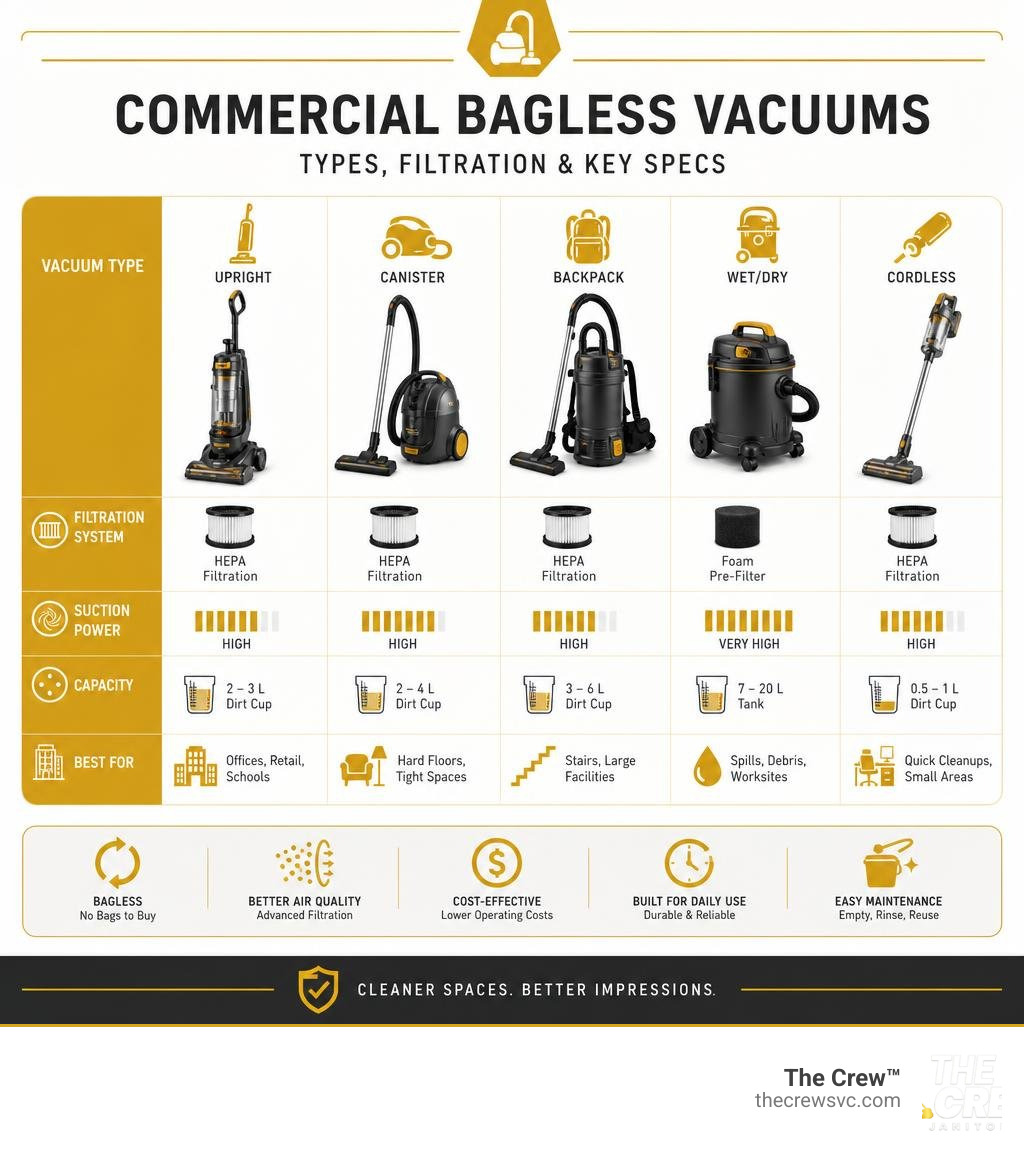
What is a Commercial Vacuum Bagless Model and How Does It Work?
A commercial vacuum bagless cleaner is designed to collect dust, dirt, and debris in a built-in, removable dirt cup or canister rather than a disposable paper or cloth bag.
Instead of forcing dirty air through the tiny pores of a paper bag, a bagless commercial vacuum uses cyclonic technology. The vacuum's motor creates a powerful, swirling vortex of air inside the canister. This centrifugal force spins heavy dirt particles and debris outward, where they drop to the bottom of the dirt cup. The remaining fine air is then pushed through multi-stage filters before being exhausted back into the room.
For property managers trying to keep up with daily wear and tear, understanding these mechanics is a key part of equipment selection. If you are looking to optimize your building's overall maintenance plan, check out our guide on Commercial Cleaning 101 for Property Managers to see how proper equipment fits into a broader janitorial strategy.
Key Differences Between Commercial and Residential Vacuums
It is common to wonder why you cannot just buy a high-end residential vacuum for your commercial space. While residential models are great for a weekly run-through of a living room, they quickly fail under the demands of a business environment.
- Motor Lifespan: Commercial motors are engineered for heavy-duty, continuous operation. High-end commercial vacuums often feature motors rated for 1,000 to 2,000 hours of active use, whereas residential vacuums are typically built to survive only a fraction of that time.
- Build Quality: Commercial bagless vacuums utilize thick, impact-resistant plastics, reinforced bumper guards, and heavy-duty power cords designed to survive being pulled around sharp desk corners and door frames.
- Continuous Operation: Residential vacuums often overheat if run continuously for hours. Commercial models are engineered with advanced cooling pathways to ensure they can run all day without thermal shutdown.
- Daily Wear Resistance: From commercial-grade brush rolls with stiff bristles to heavy-duty belts, every component of a commercial model is built to handle the abrasive dirt tracked into retail spaces and offices.
Bagless vs. Bagged Commercial Vacuums
When deciding between a bagless and a bagged commercial vacuum, there are several trade-offs to keep in mind:
- Ongoing Costs: This is where bagless vacuums shine. With a bagged vacuum, you must constantly purchase replacement bags. If you have a large facility, these costs add up fast. A bagless vacuum eliminates bag purchases entirely, lowering your total cost of ownership.
- Disposal Convenience: Bagged vacuums are generally cleaner to empty because the dust is sealed inside the bag. Bagless models require you to empty the dirt cup directly into a trash bin, which can release a small plume of dust if not done carefully.
- Suction Power: As a vacuum bag fills with dust, the pores in the paper clog, which gradually reduces suction. A bagless vacuum maintains consistent suction power until the dirt cup is completely full.
- Capacity Comparison: While some bagged uprights hold massive amounts of debris, modern commercial bagless dirt cups are designed with generous capacities (often up to several quarts) to ensure cleaners do not have to make constant trips to the dumpster.
Key Features to Prioritize When Buying a Commercial Bagless Vacuum
Investing in a commercial vacuum is a major decision. To get the best return on your investment, you should focus on a few critical features that determine how long the machine will last and how well it will perform. For a deeper look at professional floor care standards, you can explore the options available from Sanitaire Commercial: Best Commercial Grade Vacuum Cleaners.
HEPA Filtration and Indoor Air Quality in a Commercial Vacuum Bagless System
Indoor air quality is a major priority for modern businesses. When a vacuum runs, it has the potential to kick up fine dust and allergens, spreading them back into the air your employees and clients breathe.
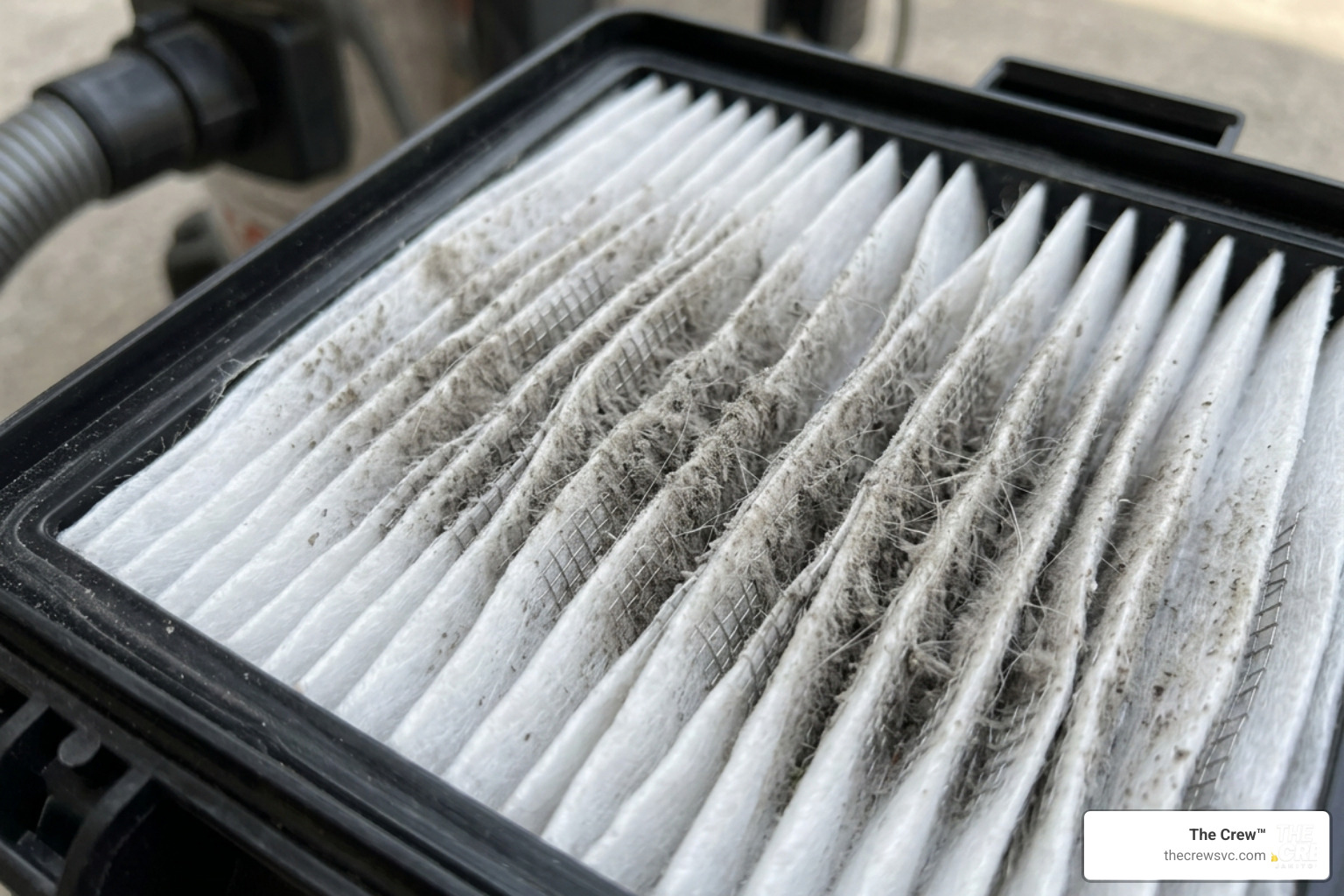
To prevent this, look for a commercial vacuum bagless system equipped with a sealed HEPA (High-Efficiency Particulate Air) filtration system. True HEPA filters (such as HEPA 13) are certified to capture 99.97% of particles as small as 0.3 microns. This includes pollen, mold spores, fine dust, and bacteria.
Multi-stage filtration is also crucial. By running the dirty air through a washable pre-motor filter first, the vacuum traps larger debris before it reaches the HEPA filter. This prevents the HEPA filter from clogging prematurely, maintaining strong suction and keeping your indoor air clean.
Multi-Surface Versatility and SONAR Technology
Many commercial buildings feature mixed flooring, such as low-pile carpet in the main offices, luxury vinyl tile (LVT) in the hallways, and ceramic tile in the breakrooms. Historically, cleaners had to manually adjust the height of the vacuum brush roll or switch machines entirely when moving between different surfaces.
Modern commercial vacuums have solved this issue. Features like the SurfaceSense technology found on the RESPONSE™ Multi-Surface Upright Vacuum SC5900A — Sanitaire Commercial use advanced SONAR sensors to detect the floor type in real time. When the vacuum transitions from carpet to hard floors, the system automatically adjusts the brush roll speed and height. This prevents the brush roll from scattering debris on hard surfaces or damaging delicate wood and tile, while ensuring deep cleaning on carpets.
Top Commercial Bagless Vacuum Models Compared
Choosing the right model depends on your specific facility layout, budget, and cleaning frequency. Here is a direct comparison of the top commercial bagless models on the market today:
| Vacuum Model | Type | Weight | Dust Capacity | Standout Feature |
|---|---|---|---|---|
| Sanitaire SL4410A | Upright (Corded) | 17 lbs | 2.9 Quarts | Heavy-duty build with on-board attachments |
| Hoover TaskVac | Upright (Corded) | 15 lbs | 1.5 Quarts | Lightweight design, easy-empty dirt cup |
| BISSELL BigGreen | Upright (Corded) | 18 lbs | 3.2 Quarts | Massive capacity, extra-wide cleaning path |
| Dyson V15 Detect Pro | Stick (Cordless) | 6.8 lbs | 0.2 Gallons | High-tech laser dust detection, ultra-lightweight |
Upright vs. Backpack Options for a Commercial Vacuum Bagless Setup
The physical design of your vacuum plays a massive role in cleaning efficiency and operator fatigue.
- Upright Vacuums: Uprights like the Sanitaire SL4410A are the traditional choice for commercial spaces. They excel at deep-cleaning carpets because the heavy motor sits directly over the brush roll, pushing the bristles deep into the carpet fibers. They are highly intuitive to use and usually feature on-board tools for quick detail cleaning.
- Backpack Vacuums: While most backpack vacuums are bagged systems — such as the TRANSPORT® Backpack Vacuum SC412B — Sanitaire Commercial or the heavy-duty TRANSPORT® Commercial Corded Backpack Vacuum SC570A — Sanitaire Commercial — they are worth mentioning for their sheer productivity. Backpack vacuums allow cleaners to move quickly through tight spaces, around desks, and up stairwells, reducing cleaning times by up to 46% compared to traditional uprights.
- High-Tech Handhelds: If you need a highly maneuverable, lightweight touch-up tool to complement your heavy uprights, a cordless stick model like the Dyson V15 Detect Pro is an excellent addition to your fleet. It is perfect for quick spot-cleaning in lobbies, conference rooms, and high surfaces.
Corded vs. Cordless Commercial Models
Another key decision is choosing between the unlimited run time of a corded vacuum and the portability of a cordless model.
- Corded Models: Most commercial bagless uprights feature 40- to 50-foot heavy-duty cords. This gives you unlimited runtime and maximum suction power. However, managing a long cord requires care to avoid creating trip hazards in active workplaces.
- Cordless Models: Cordless commercial vacuums offer incredible freedom of movement and eliminate trip hazards entirely. Advanced cordless stick vacuums often come with interchangeable, click-in batteries that can provide up to 120 minutes of continuous runtime. The trade-off is a smaller dirt cup capacity and the need to manage battery charging schedules.
Maintenance and Total Cost of Ownership
A commercial vacuum is an investment. To maximize its lifespan and keep your total cost of ownership as low as possible, routine maintenance is essential. Neglecting basic care can lead to clogged filters, strained motors, and a noticeable drop in suction power.
Regular vacuum maintenance is a core part of keeping your facility in top shape. If you want to see how vacuum care fits into a complete building maintenance schedule, read our comprehensive guide on The Ultimate Guide to Deep Cleaning Your Denver Business.
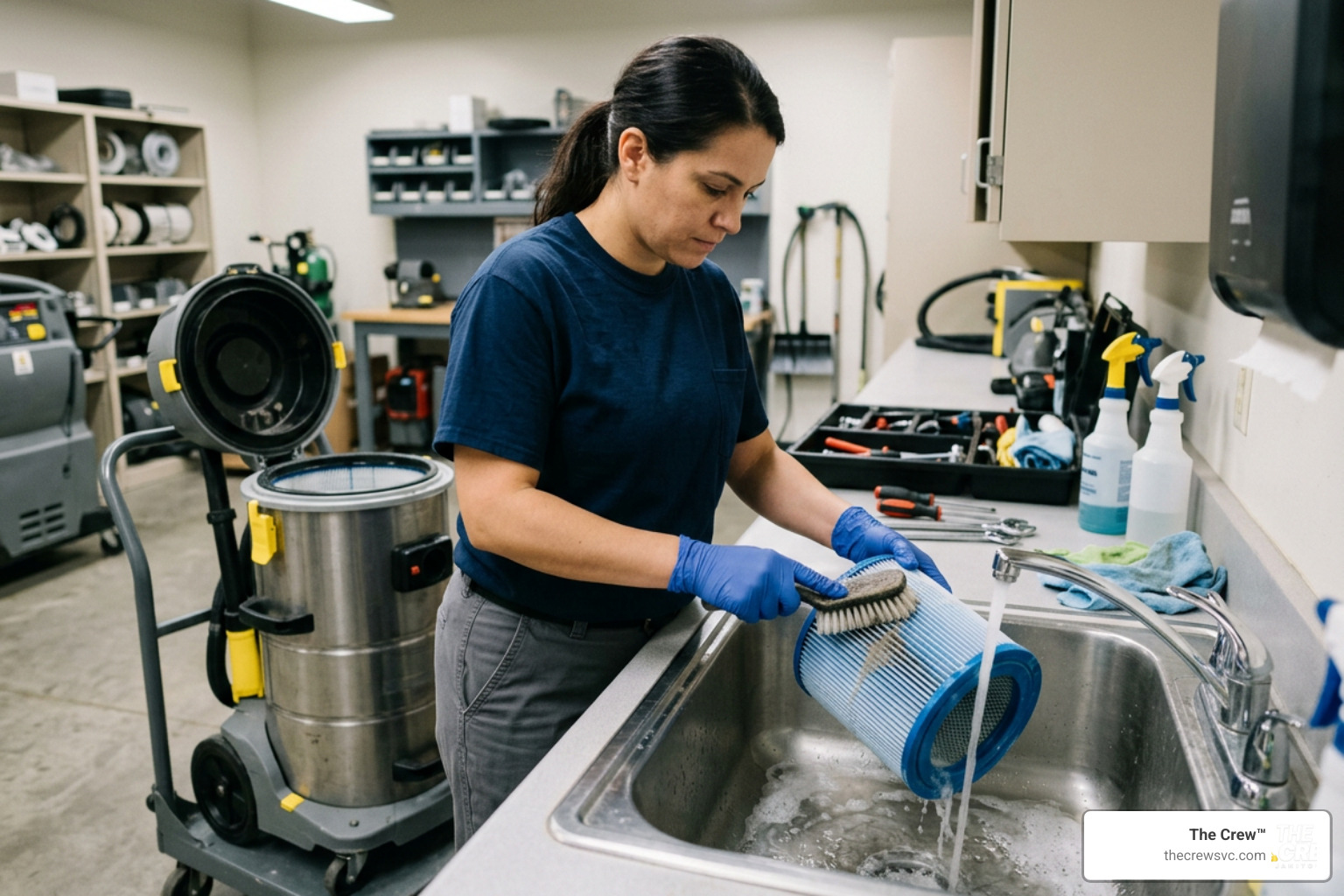
Cleaning and Washing Reusable Filters
The primary reason bagless vacuums lose suction is a dirty filter. When fine dust builds up on the filter, it restricts airflow, forcing the motor to work harder and run hotter.
- Check the Filter Regularly: In a busy commercial setting, check the pre-motor filter at least once a week.
- Wash with Cold Water: Most commercial bagless pre-filters are designed to be washable. Rinse them under cold, running water without using harsh soaps or detergents.
- Allow Complete Drying Time: This is the most critical step. Never put a damp filter back into a vacuum. It must air-dry completely for at least 24 hours. Placing a wet filter in the machine can ruin the motor and cause mold to grow inside the housing.
- Inspect the HEPA Filter: While pre-filters are washable, HEPA filters usually need to be replaced periodically (typically every 6 to 12 months depending on usage) to maintain optimal indoor air quality.
Emptying the Dust Cup Safely
Because bagless vacuums do not have a self-sealing bag, emptying the dirt cup requires a bit of care to keep dust from escaping back into your clean facility.
- Empty Early: Do not wait for the dirt cup to fill to the brim. Empty it when it reaches the "Max Fill" line to maintain optimal airflow.
- The "Bag-in-Bag" Method: Place the bottom of the dirt cup deep inside a large commercial trash bag before releasing the trap door. This contains the dust plume within the trash bag.
- Wipe Down the Seals: Periodically wipe the rubber gaskets and seals around the dirt cup lid with a damp microfiber cloth. This ensures a tight seal and prevents fine dust from leaking out of the canister during operation.
Frequently Asked Questions About Commercial Bagless Vacuums
Are bagless vacuums suitable for high-traffic commercial environments?
Yes, modern commercial bagless vacuums are highly suitable for high-traffic environments. High-quality models are built with durable, impact-resistant polycarbonate canisters and heavy-duty motors that can handle hours of daily use. However, because they lack a bag to contain fine dust, you must commit to a strict filter cleaning schedule to keep them running efficiently in very dusty or high-traffic spaces.
How often do you need to clean or replace HEPA filters in commercial models?
For most commercial settings, pre-filters should be washed every month (or more frequently in high-dust environments). True HEPA filters cannot typically be washed and should be replaced every 6 to 12 months. If you notice a drop in suction power or a dusty smell when the vacuum runs, it is usually a sign that the filters need immediate attention.
Where can businesses purchase or rent reliable commercial vacuums?
If you are operating a business in the Denver Metro Area, you have several excellent local options for sourcing commercial vacuums:
- Local Sales and Service: For expert advice, customized fittings, and local repairs, check out Commercial Vacs Highlands Ranch | Vacuums for Business Aurora or explore regional manufacturers through Colorado - Vacuum Cleaner Manufacturers.
- Rental Options: If you only need a heavy-duty vacuum for a short-term cleanup or a specific project, renting is a highly cost-effective choice. You can find convenient rental locations across the metro area, such as Where to Get a Rental Vacuum in Lakewood, CO - Locations, Shop Vacuums in Longmont, CO - Rent-A-Center, and Shop Vacuums in Westminster, CO - Locations - Rent-A-Center.
Conclusion
Selecting the right commercial vacuum bagless system is a smart way to lower your ongoing supply costs, maintain strong suction power, and keep your floors looking pristine. By prioritizing high-quality HEPA filtration, durable build quality, and smart features like automatic surface detection, you can keep your facility running smoothly.
Of course, even the best vacuum is only as good as the person operating it. Managing a busy facility means your time is valuable, and worrying about vacuum maintenance, cleaning schedules, and janitorial staffing can quickly become a full-time job.
That is where we come in. At The Crew™, we provide top-tier commercial cleaning and janitorial services throughout the Denver Metro Area, including Aurora, Lakewood, Commerce City, Brighton, Longmont, Westminster, Highlands Ranch, and surrounding cities.
We do things differently. Our unique strength is our ability to hire and retain the very best cleaning professionals. With 0% turnover, our background-checked cleaners stay with us long-term, giving your business the consistent, reliable, and high-quality clean it deserves every single day.
Let us handle the heavy lifting. Contact us today to request a quote and experience the difference of working with The Crew Commercial Cleaning Services.