Why Commercial Cleaning Companies Must Prioritize Employee Vetting
Running a commercial cleaning operation involves a massive amount of trust. As commercial cleaners operating across the Denver Metro Area—from Lakewood and Englewood to Commerce City and Westminster—we know that facility managers are not just paying for spotless floors and sanitized restrooms; they are trusting us with their master keys, access keycards, proprietary data, and high-value equipment.
Without comprehensive vetting, a cleaning company exposes its clients, staff, and overall business to severe operational and financial risks.
Building Client Trust and Safeguarding Assets
When our crews enter a facility after hours in locations like Broomfield or Centennial, they operate largely unsupervised. They work near unlocked drawers containing confidential corporate documents, expensive IT infrastructure, trade secrets, and personal employee belongings. Establishing a rigid background screening protocol is the absolute foundation of building client trust.
If a commercial property owner hands over security clearance, they need absolute confidence that the personnel walking their halls are fully vetted. Beyond protecting physical property, routine background checks safeguard sensitive corporate environments from physical breach or data compromise. Building owners don't just want clean desks—they need to know how to spot top-level talent. Utilizing clear screening standards allows property managers to evaluate their options confidently; reviewing How to Spot Top Cleaners with Vetted Backgrounds offers great perspective on what proper vetting looks like in practice.
Qualifying for Insurance, Employee Dishonesty Bonds, and Lower Rates
Beyond client peace of mind, thorough employee screening directly impacts a cleaning company's bottom line by unlocking access to commercial insurance policies and employee dishonesty bonds.
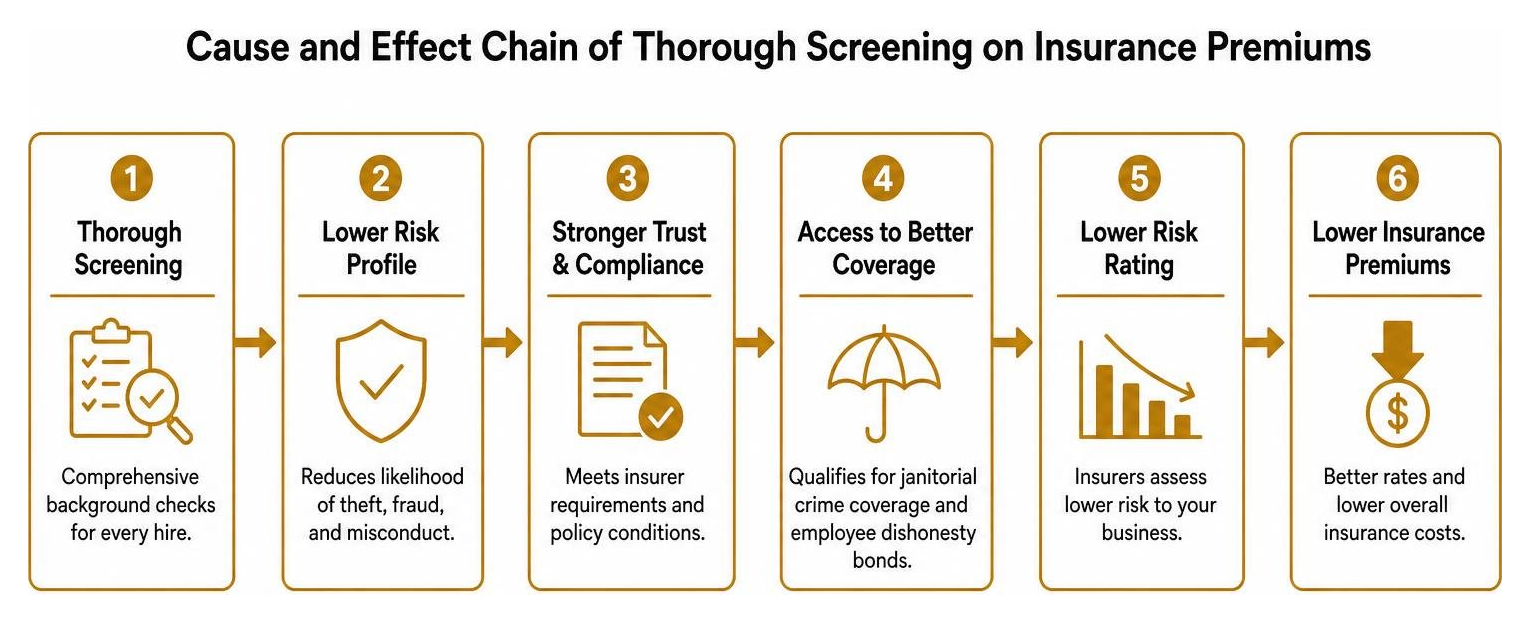
Underwriters carefully evaluate a janitorial service provider's hiring protocols before approving coverage. Janitorial crime coverage and employee dishonesty bonds—which protect clients if internal theft occurs—frequently require proof of standard pre-employment background screening as a policy condition.
Failing to maintain documented proof of office cleaning background checks can result in:
- Outright denial of janitorial crime bond coverage.
- Higher general liability insurance premiums due to elevated risk ratings.
- Denied insurance claims if an unvetted employee commits a crime on client premises.
By maintaining consistent, documented screening practices for every worker, commercial cleaning providers dramatically reduce insurance claim frequencies, keeping policy rates manageable over time. Property owners evaluating janitorial providers should never take security for granted; learning why you Don't Let Strangers In: How to Find Top Vetted Cleaners highlights how essential bonded and insured personnel are for long-term risk management.
Essential Components of Comprehensive Office Cleaning Background Checks
A simple, single-source search is rarely enough when screening personnel for high-trust commercial environments. A thorough background check framework relies on a layered search approach to capture accurate, up-to-date information across various jurisdictions.
| Search Type | Jurisdiction / Database Covered | What It Uncovers | Primary Limitation |
|---|---|---|---|
| Social Security Number (SSN) Trace | Credit bureaus & public record databases | Alias names, maiden names, address history (past 7–10 years) | Does not return criminal record convictions directly. |
| County Criminal Search | Specific county court dockets | Misdemeanor & felony convictions, pending court cases | Only covers the specific county searched. |
| Statewide Criminal Database | State central repositories | Multi-county state records | Data feed latency; missing county updates. |
| Federal District Court Search | U.S. Federal District Courts | Embezzlement, identity theft, federal drug trafficking, bank fraud | Does not include local misdemeanor or county felony charges. |
| National Sex Offender Registry | 50-state sex offender databases | Registered sex offender status | Requires verification at the primary county source. |
County, State, and Federal Criminal Searches
A major misconception in commercial janitorial hiring is that a quick "national background check" covers all bases. In reality, over 90% of criminal record data in the United States resides directly within local county court dockets, not in a single, unified national database. National checks act as broad nets, but primary county court searches must be executed based on the candidate's address history trace to pull direct court dockets.
Furthermore, traditional state and county background searches completely miss federal criminal records. Federal offenses are maintained in an entirely separate court system. Approximately 10% of the 2 million people incarcerated in the United States are held in Federal Bureau of Prisons custody, and 10% of the 6.8 million individuals under probation or parole are supervised by federal authorities. Federal courts handle crimes such as:
- Identity theft and financial bank fraud
- Embezzlement and counterfeiting
- Federal drug trafficking and weapons charges
If a cleaning provider relies solely on local state checks, an applicant with a clean local record might have an open federal record for identity theft. For deeper insight into how federal checks integrate with commercial screening, consult the guide on Janitorial Services Employment Background Checks - National Employment Screening.
Work Authorization, SSN Traces, and Identity Verification
Before initiating criminal record searches, screening must begin with a Social Security Number (SSN) trace. The SSN trace maps out the applicant's complete address history and reveals alternate names, maiden names, or legal aliases used over the past 7 to 10 years. Searching every jurisdiction an applicant has lived in ensures that hidden records under prior addresses or legal names are uncovered.
Simultaneously, legal work authorization must be handled carefully. Under federal immigration law, every employer must complete and retain Form I-9 (Employment Eligibility Verification) within three business days of a new hire's first day of work. Work authorization verification is a separate legal mandate from criminal background checks. Federal regulators strictly penalize improper hiring documentation. Ensuring your commercial provider utilizes Business Cleaning Vetted Staff guarantees that both criminal vetting and legal work authorization obligations are flawlessly met.
Legal Compliance: FCRA Rules, EEOC Guidelines, and Fair Hiring
Running office cleaning background checks isn't just about collecting data—it is about following federal, state, and local employment laws. Operating in Colorado cities like Denver, Arvada, Golden, and Aurora requires strict adherence to legal frameworks designed to protect candidate rights and eliminate discriminatory hiring practices.

Navigating the Fair Credit Reporting Act (FCRA)
When a cleaning company uses a third-party Consumer Reporting Agency (CRA) to perform background checks, it is legally bound by the Fair Credit Reporting Act (FCRA). Statutory penalties for FCRA non-compliance range from $100 to $1,000 per violation, plus legal fees and class-action exposure.
To stay fully FCRA-compliant, employers must execute a rigid multi-step workflow:
- Standalone Written Disclosure: The candidate must be given a clear, standalone document stating that a background report will be ordered for employment purposes. This disclosure cannot be hidden inside a standard employment application.
- Explicit Written Consent: The candidate must provide signed written authorization before the background check is ordered.
- Pre-Adverse Action Notice: If background check findings might cause the company to deny employment, the employer cannot immediately reject the candidate. They must issue a Pre-Adverse Action Notice including a copy of the actual background report and a summary of the candidate's rights under the FCRA.
- Mandatory Waiting Period: The employer must wait 3 to 5 business days, giving the candidate an opportunity to review the report, dispute incorrect court data, or provide context.
- Final Adverse Action Notice: If the decision to withhold an offer stands after the waiting period, a formal Final Adverse Action Notice must be issued to the applicant containing CRA contact details.
To review an operational compliance framework for these steps, explore the comprehensive Cleaning Business Background Checks: FCRA Playbook.
Conducting Individualized Assessments for Candidate Hits
Roughly 1 in 4 background checks (25%) return a "hit"—which simply means a court record or discrepancy of some kind exists. However, a hit is not an automatic cause for rejection.
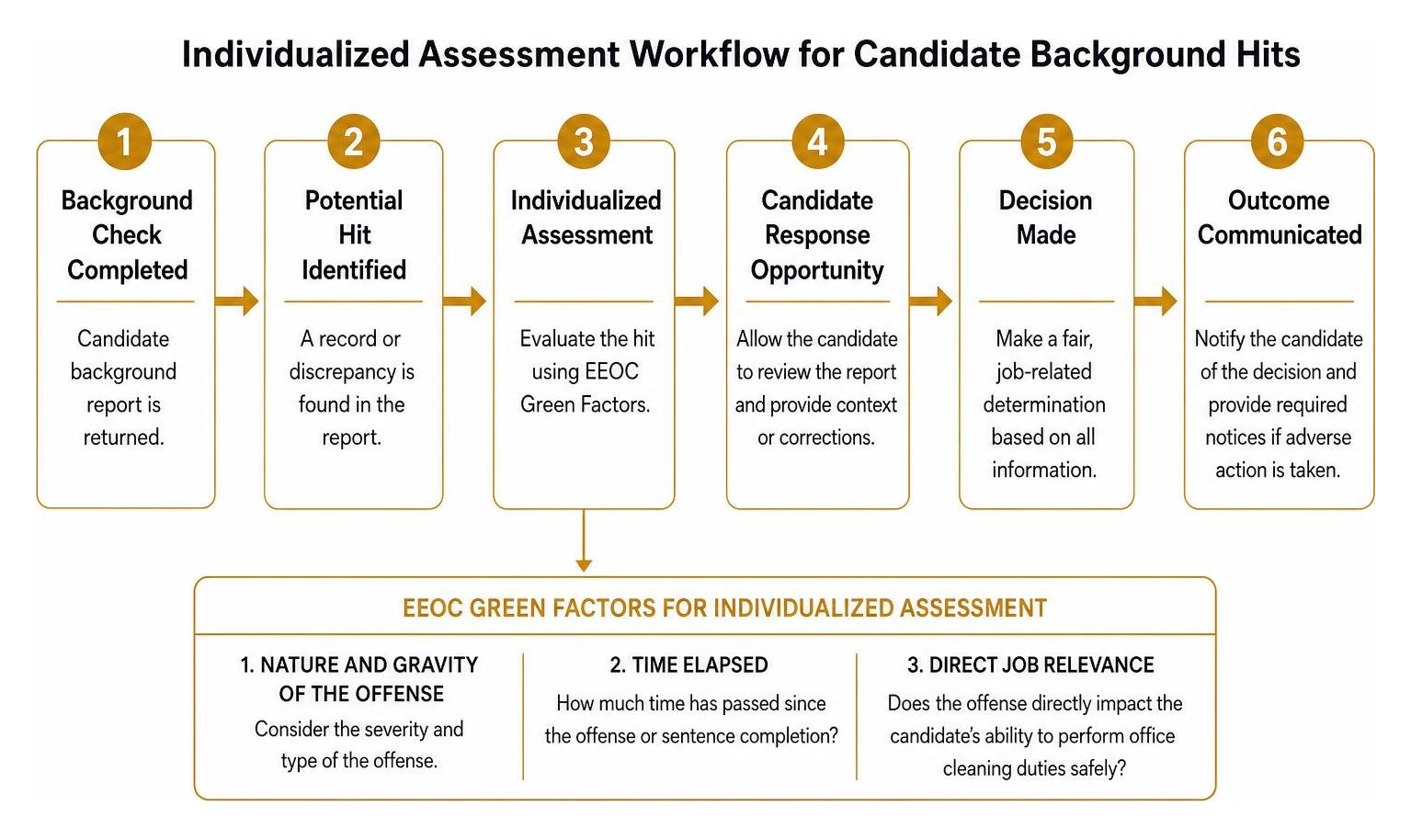
Under Equal Employment Opportunity Commission (EEOC) guidance, blanket rules like "we do not hire felons" are illegal because they create an unlawful discriminatory impact. Instead, employers must perform an individualized assessment evaluating the EEOC "Green Factors":
- The nature and gravity of the offense: Was it a violent crime, a property crime, or a minor non-violent infraction?
- Time elapsed: How much time has passed since the offense occurred or sentence completion? (e.g., a 10-year-old conviction vs. a 6-month-old charge).
- Direct job relevance: Does the offense directly impact the candidate's ability to perform office cleaning duties safely? (e.g., a past driving violation has little relevance to a night-shift office cleaner who does not operate company vehicles).
Embracing fair hiring practices and second-chance hiring allows cleaning providers to recruit reliable, dedicated team members safely. Evaluating candidate history fairly builds a stable workforce while respecting legal standards. For an overview of how top Denver cleaning firms manage these vetting procedures, see Top Commercial Cleaning Firms in Denver with Rigorous Vetting.
Best Practices for Evaluating Providers and Re-Screening Staff
Maintaining high security in office buildings across Broomfield, Longmont, and Parker requires partnering with professional background check vendors and instituting continuous employee oversight.
Selecting a Compliant Screening Provider for Office Cleaning Background Checks
Not all background check providers offer equal quality. When selecting a Consumer Reporting Agency (CRA) to handle office cleaning background checks, commercial cleaning companies should evaluate vendors against clear criteria:
- FCRA Compliance & CRA Accreditation: Ensure the vendor is accredited by the Professional Background Screening Association (PBSA).
- Direct County Access: Confirm that the provider executes direct county courthouse searches rather than relying solely on stale, aggregated state databases.
- Transparent Pricing: Standard pre-employment screening typically ranges between $25 and $50 per applicant. Watch for mandatory monthly software fees versus flexible pay-as-you-go structures. 307 U.S. counties charge additional court pass-through access fees ranging from $1 to $95.
- Turnaround Speed & Accuracy: Look for digital portals offering standard 24- to 48-hour turnarounds while maintaining human verification steps for court record matches.
To understand how rigorous vetting connects with operational risk management, read our guide on How to Hire a Bonded Janitorial Service in Denver Without the Stress.
Establishing Annual Re-Screening Workflows for Active Cleaners
Initial pre-employment screening only captures a candidate's past up to their hire date. However, an employee who was clear when hired three years ago might acquire a disqualifying criminal charge while currently employed.
A robust risk management strategy includes re-screening all active cleaning personnel every 12 months. Periodic re-screening ensures continuous property security for long-term commercial clients. To perform annual re-screening legally, employers must ensure their initial onboarding consent form explicitly includes "ongoing authorization throughout employment" language or collect fresh consent forms annually. Establishing routine re-screening policies creates operational stability; explore how continuous oversight supports a Stable Staff Cleaning Company.
Common Misconceptions and Legal Pitfalls in Janitorial Screening
Navigating background screening requires separating common industry myths from legal reality. Errors in screening procedures can expose cleaning companies to devastating legal penalties.

Avoiding Blanket Criminal Bans and Misleading Screening Myths
- Myth 1: "Subcontractors (1099s) don't need background checks."
Fact: Independent contractors walk through the exact same client facilities as W-2 employees. A security breach caused by an unvetted 1099 contractor creates identical liability for the cleaning business and property manager. - Myth 2: "State databases are 100% complete."
Fact: As noted earlier, over 90% of criminal data resides in county courthouses. State databases often lag months behind direct county dockets. - Myth 3: "We can screen candidate social media accounts freely."
Fact: Informal social media reviews frequently expose hiring managers to protected class information (age, religion, sexual orientation, disability status), opening the business to discrimination lawsuits. Social media checks should only be performed by FCRA-compliant third parties who redact protected characteristics. - Myth 4: "Ban-the-Box laws don't apply to small cleaning companies."
Fact: Numerous states and local municipalities enforce "Ban the Box" laws that prohibit asking criminal history questions on initial job applications. Criminal inquiries can only occur after an initial interview or conditional job offer.
Implementing structured screening policies protects both staff and clients. Understanding why vetted professionals matter helps building owners appreciate the value of specialized roles like day porters; read Why Vetted and Reliable Day Porters Are Worth the Investment for more details.
Addressing Pitfalls in Office Cleaning Background Checks
The financial consequences of ignoring background screening and legal work authorization compliance are immense:
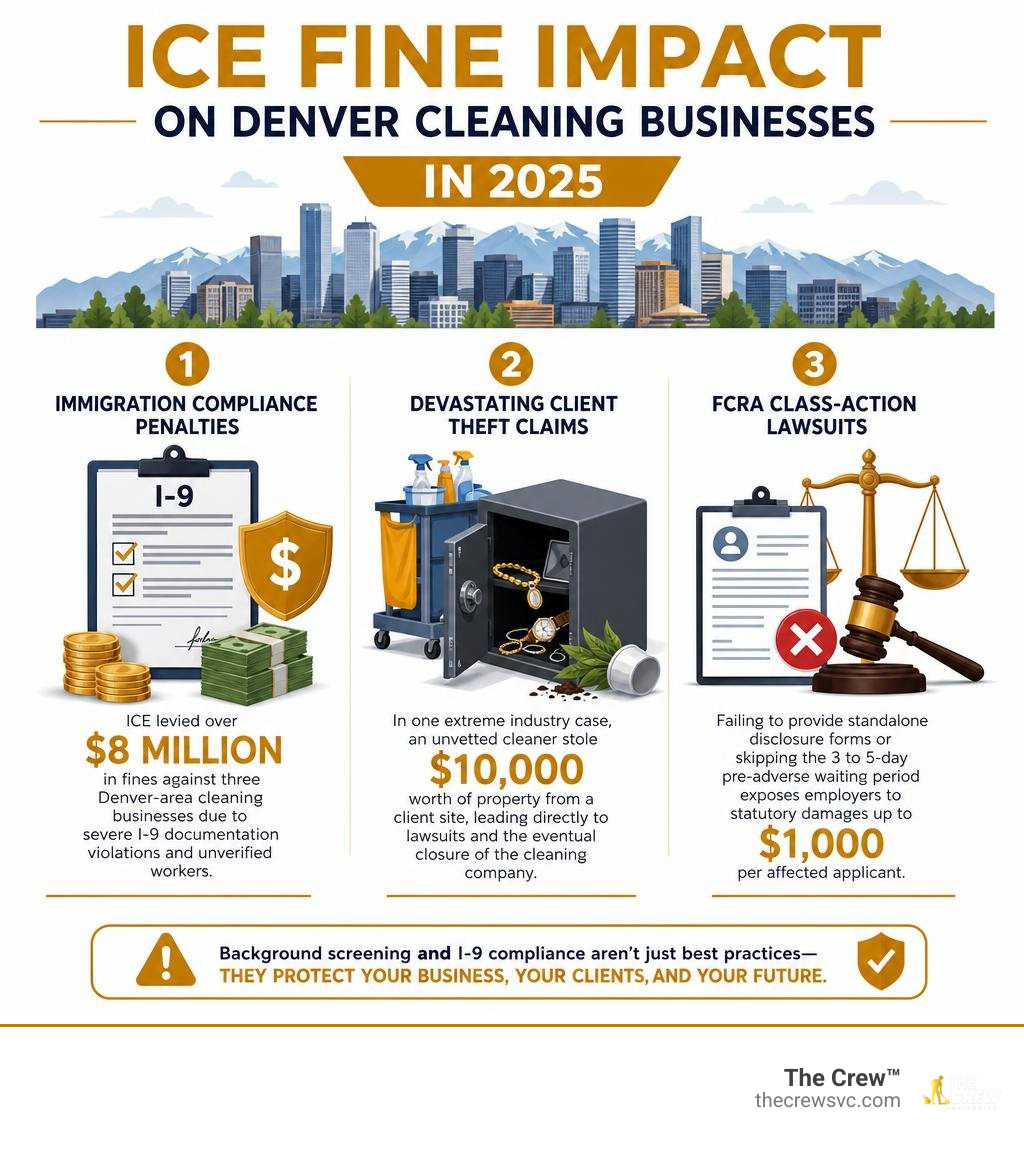
- Immigration Compliance Penalties: In 2025, Immigration and Customs Enforcement (ICE) levied over $8 million in fines against three Denver-area cleaning businesses due to severe I-9 documentation violations and unverified workers.
- Devastating Client Theft Claims: In one extreme industry case, an unvetted cleaner stole approximately $10,000 worth of property from a client site, leading directly to lawsuits and the eventual closure of the cleaning company.
- FCRA Class-Action Lawsuits: Failing to provide standalone disclosure forms or skipping the 3 to 5-day pre-adverse waiting period exposes employers to statutory damages up to $1,000 per affected applicant.
By combining fair hiring practices with strict operational workflows, cleaning providers achieve low turnover and clean legal records. To see how structured hiring fosters workplace longevity, explore our approach to Zero Staff Turnover Cleaning.
Frequently Asked Questions about Office Cleaning Background Checks
Are background checks legally required for commercial office cleaners?
While direct federal statutes do not explicitly mandate background checks for private commercial cleaning personnel, they are practically required. Commercial liability insurance policies, employee dishonesty bonding carriers, and corporate client contracts almost universally mandate documented pre-employment criminal background checks as a non-negotiable condition of service.
What should a cleaning business do if a background check returns a criminal hit?
When a report returns a hit (which happens in about 25% of checks), the employer should not instantly reject the candidate. First, issue a formal Pre-Adverse Action Notice containing a copy of the CRA report and FCRA Summary of Rights. Allow 3 to 5 business days for the candidate to review the findings, report errors, or offer context. Perform an individualized assessment using EEOC Green Factors—evaluating offense gravity, age of the record, and direct relevance to office cleaning tasks—before making a final hiring decision.
How often should commercial janitorial employees be re-screened?
Best practices dictate re-screening all active commercial cleaning personnel every 12 months. Annual re-screening identifies post-hire criminal records or license suspensions, ensuring that ongoing facility security standards are maintained throughout the employee's tenure.
Securing Your Workplace with Fully Vetted Cleaning Crews
Maintaining compliant, rigorous office cleaning background checks is essential for protecting commercial properties, ensuring insurance coverage, and creating fair workplace opportunities. Across the Denver Metro Area—including Denver, Lakewood, Commerce City, Littleton, Wheat Ridge, Centennial, and Highlands Ranch—building managers require cleaning teams that combine security compliance with flawless operational execution.
At The Crew™, we take employee vetting and retention to the highest professional standard. Unlike industry benchmarks plagued by chronic turnover, our company maintains 0% staff turnover. Every member of our commercial cleaning and day porter staff undergoes rigorous identity verification, work authorization checking, and full background screening. By investing in our personnel and paying living wages, we deliver unmatched service consistency and absolute peace of mind for corporate facility managers.
Discover how our background-checked, low-turnover teams elevate facility standards by reviewing our commitment to Professional Cleaners Zero Turnover and seeing how we maintain a Stable Janitorial Crew Denver.
Ready to partner with a fully vetted, reliable commercial cleaning provider? Explore Commercial Cleaning Services with The Crew™ today and request a customized facility quote.